
NSW Learner Driver Log Book & Coaching Curriculum
Essential training references, coaching methodologies, logbook guidelines, and teaching toolkits for trainee driving instructors and supervising drivers across New South Wales.
1. Curriculum Framework & 20 Learning Goals
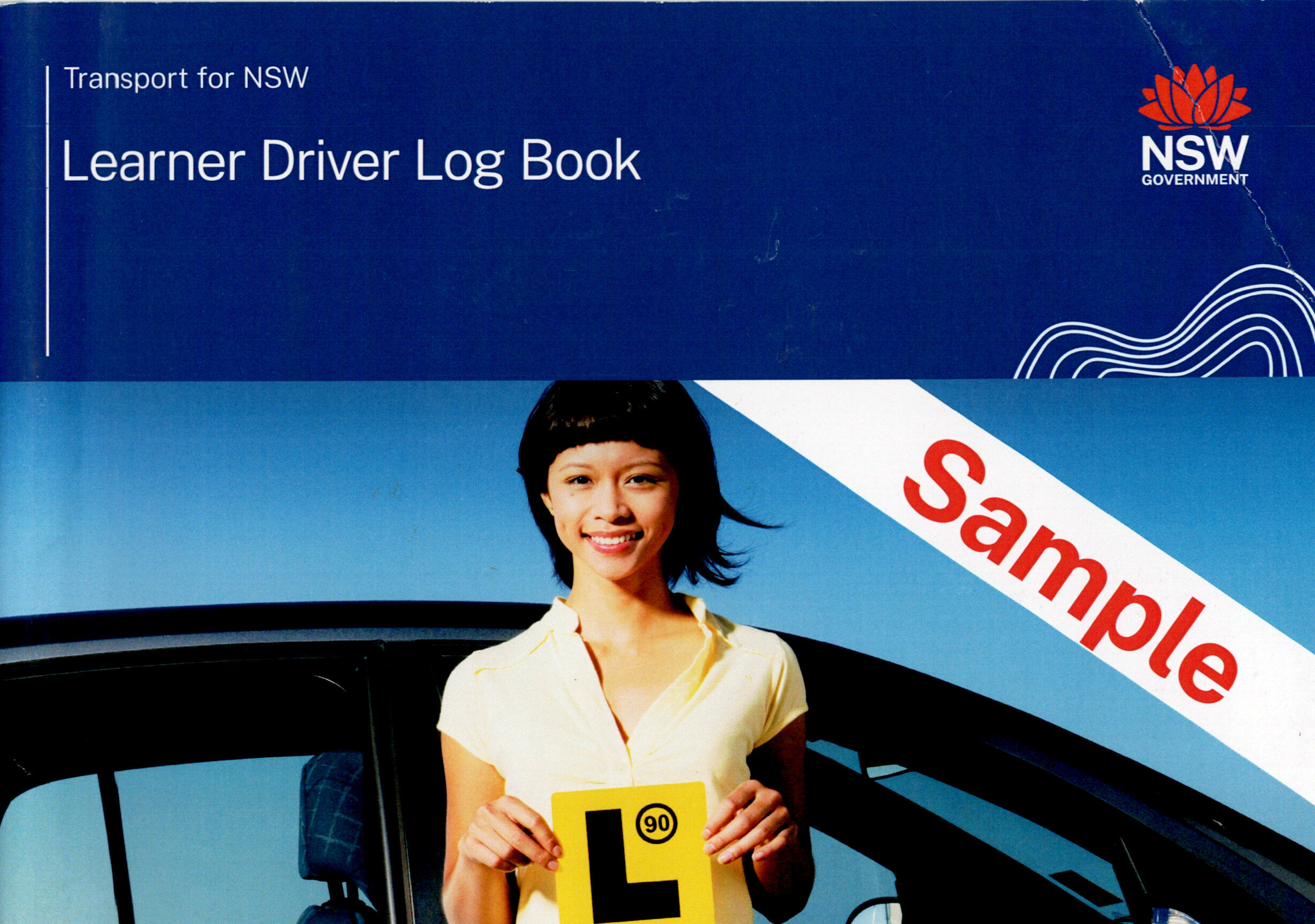
About the Log Book & Road Rules
Core statutory guidance regarding the NSW Road User Handbook, road rules legislation, and the foundation skills required for licensing tests.
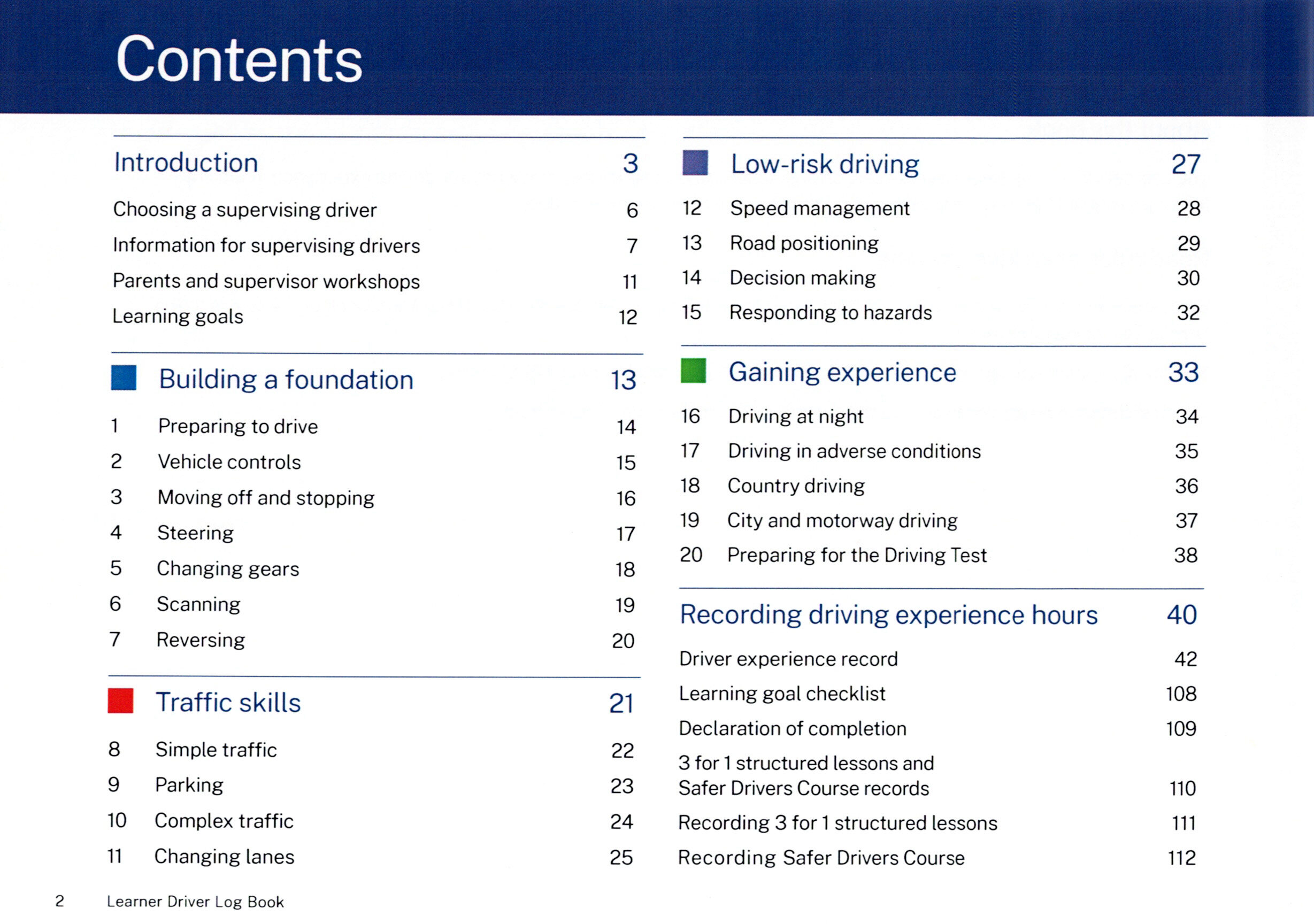
20 Structured Learning Goals
Four sequential training tiers: Building a Foundation (1–7), Traffic Skills (8–11), Low-Risk Driving (12–15), and Gaining Experience (16–20).
2. Logbook Hours, Schemes & Test Integrity
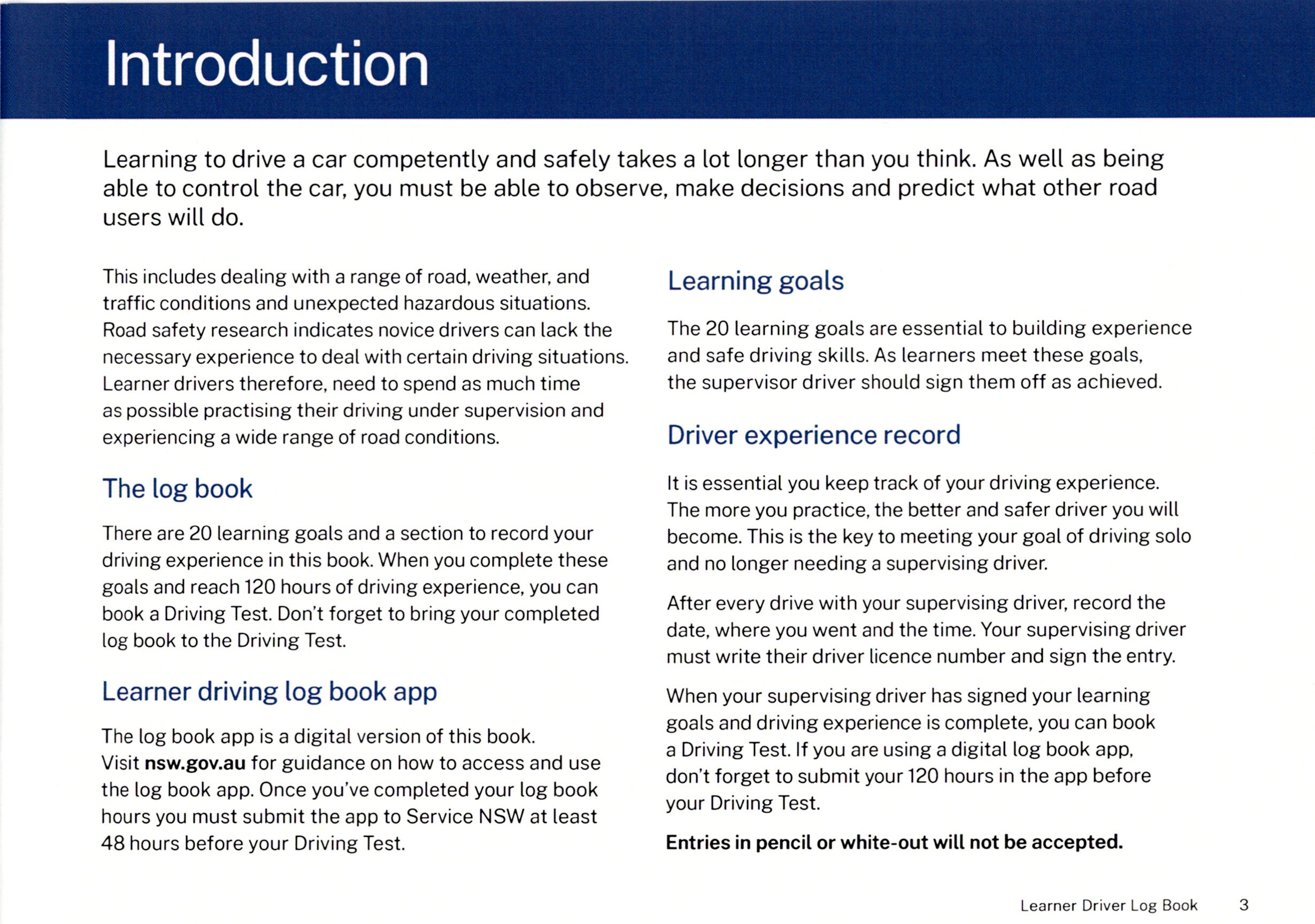
Driver Experience & App Guidelines
Rules for logging supervisor details and ensuring digital app hours are transmitted at least 48 hours prior to test appointments.
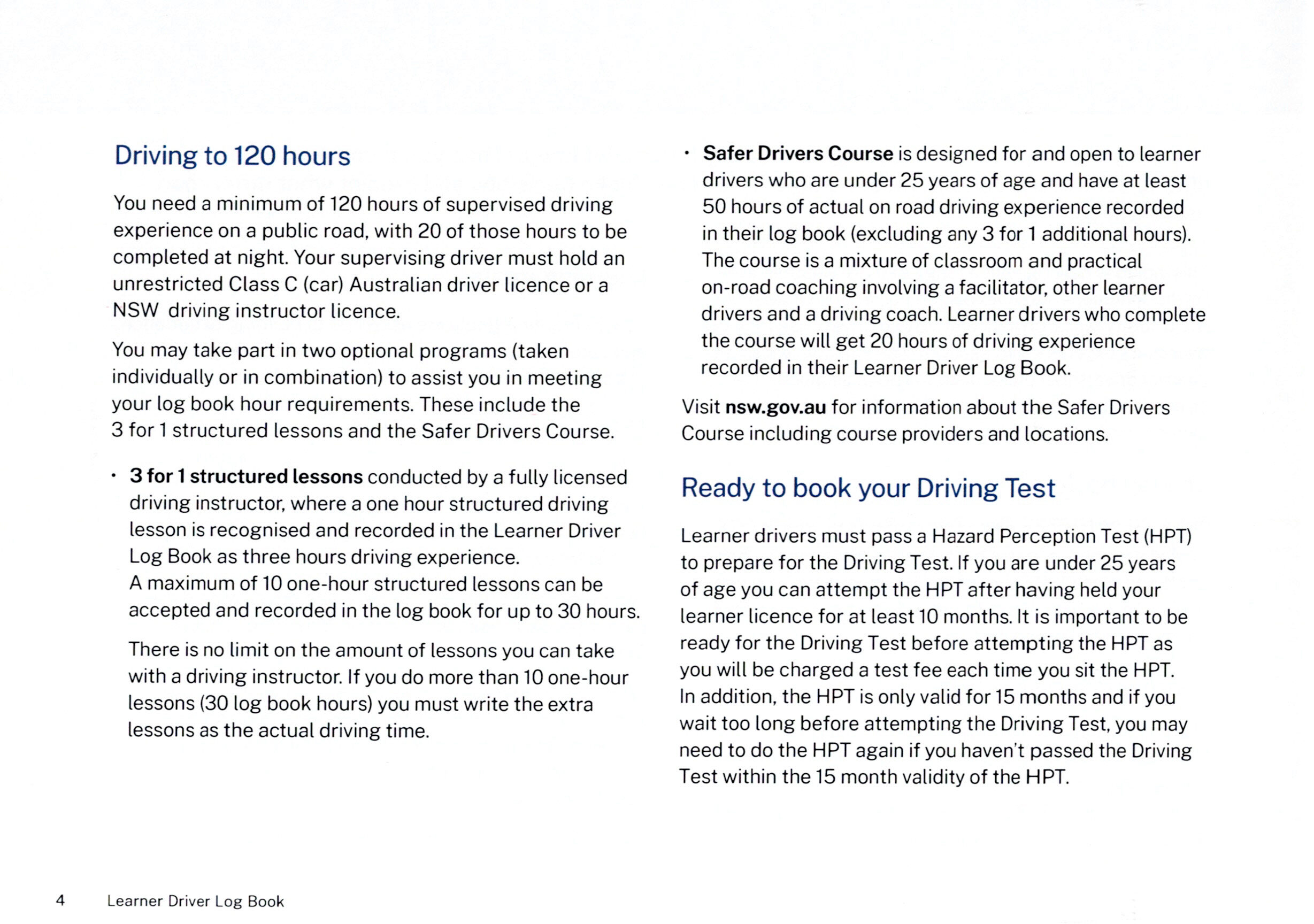
120 Hours, 3-for-1 & SDC
Structured hours calculation: up to 30 hours for 10 professional lessons, 20 hours credit for the Safer Drivers Course, and 20 mandatory night hours.
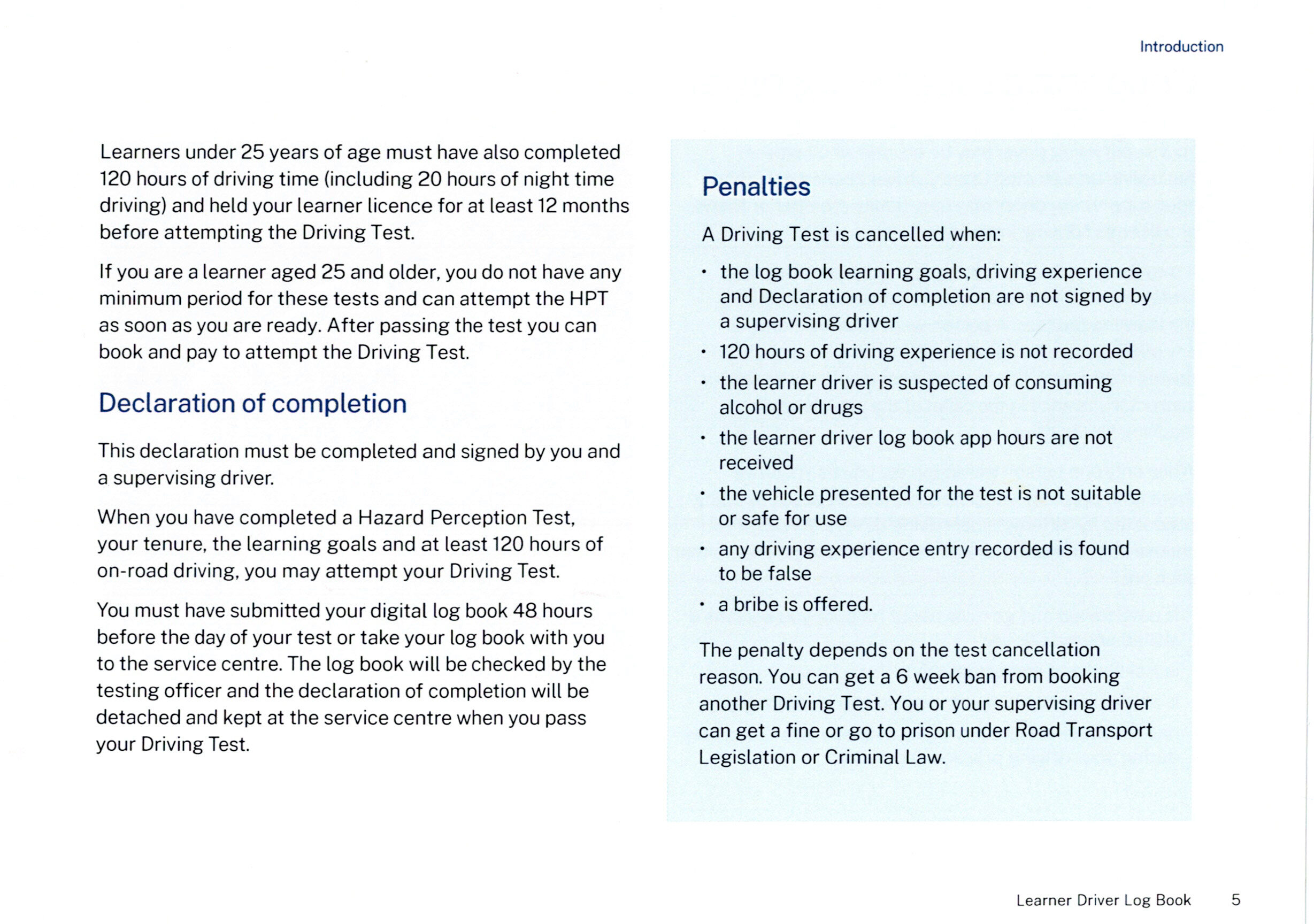
Declaration & Test Penalties
Mandatory completion declarations, vehicle presentation standards, test cancellation criteria, and legal penalties for fraudulent entries.
3. The 5-Step Driver Coaching Method
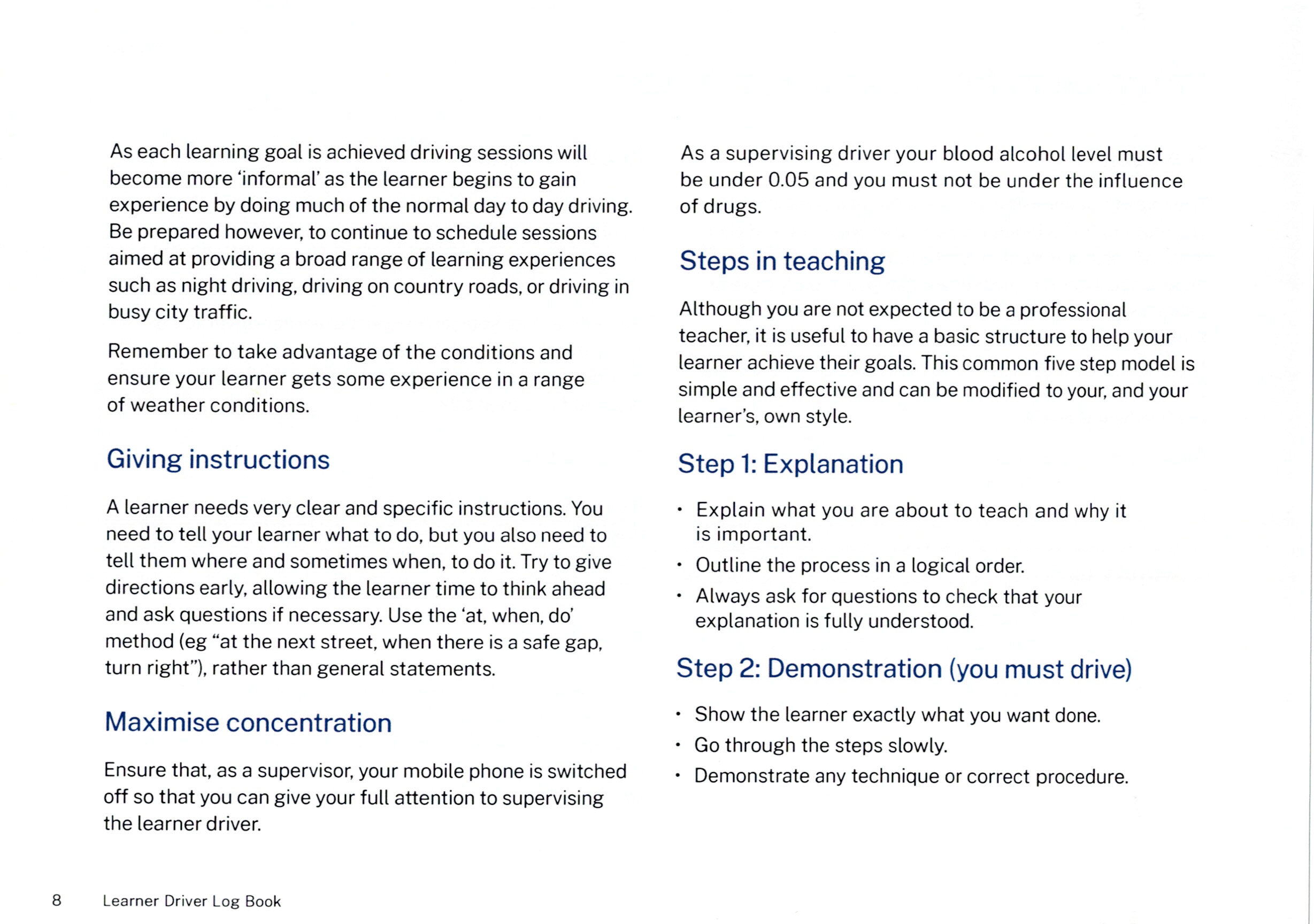
Steps 1 & 2: Explanation & Demonstration
Setting structured lesson goals, delivering 'At, When, Do' directional instructions, and executing clear in-cabin demonstrations.
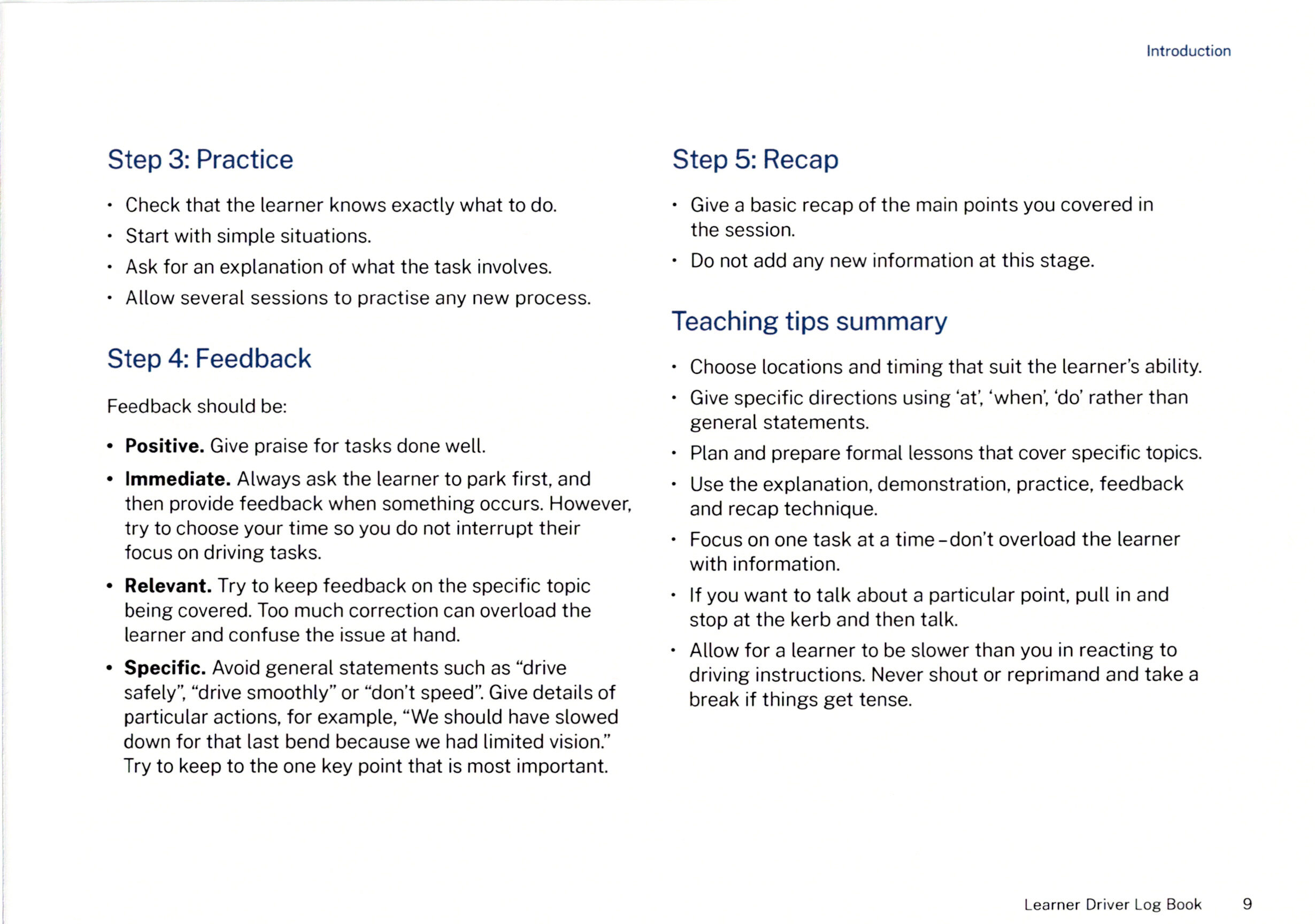
Steps 3, 4 & 5: Practice, Feedback & Recap
Guiding learner practice in quiet environments first, delivering positive kerb-side feedback, and concluding with a concise lesson debrief.
4. Supervision Guidelines & In-Cabin Best Practice
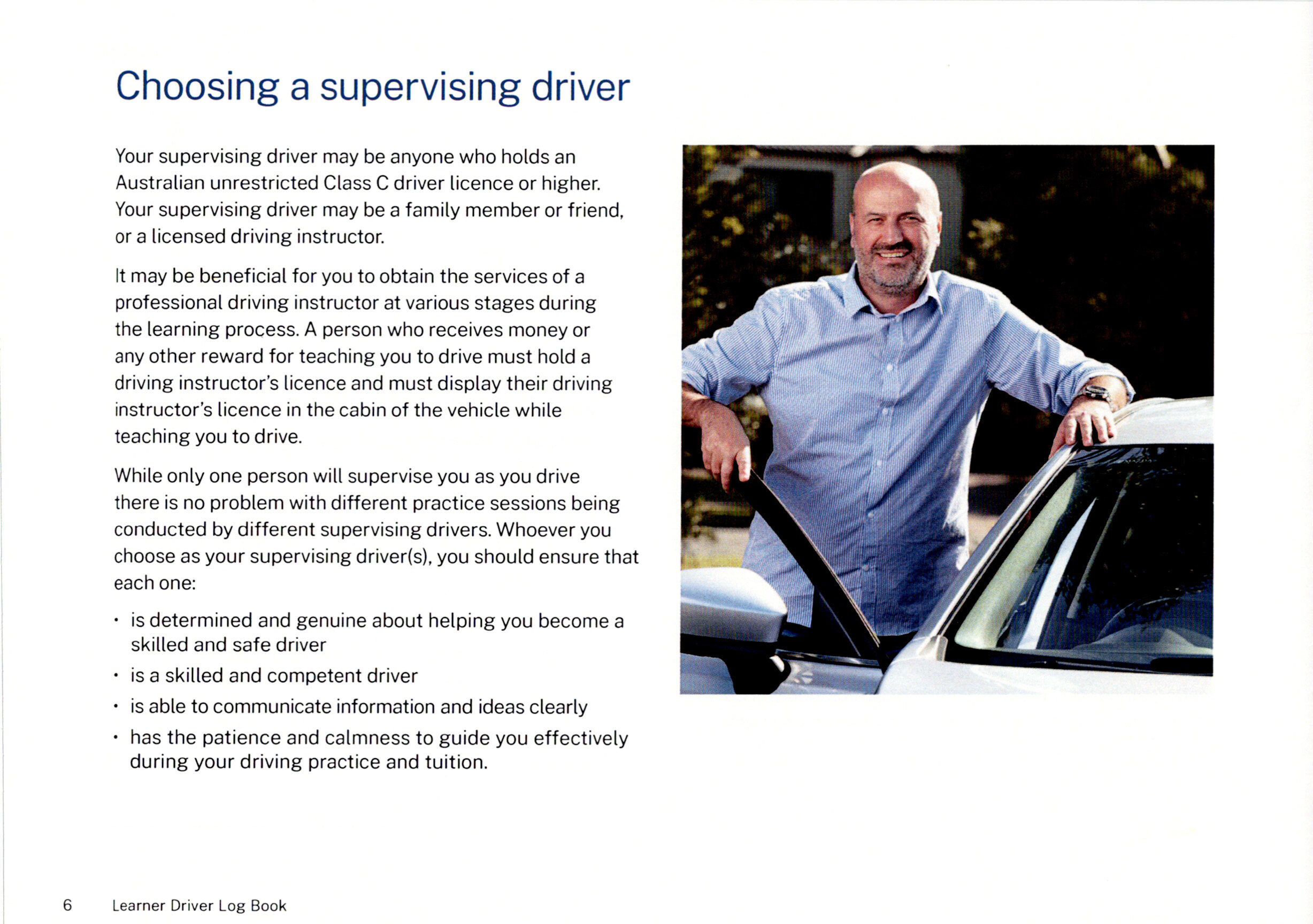
Choosing a Supervising Driver
Full licence requirements, legal supervisor responsibilities, patience, and when to engage an accredited professional driving instructor.
Teaching Tips & Planning
Keeping communication simple, maintaining driver composure, structured planning, and installing detachable auxiliary mirrors.
Twelve Supervision Rules
Pacing practice sessions, fostering speed sensitivity, implementing commentary driving, and eliminating mobile phone distractions.
5. Supervisor Workshops & Stage 1 Foundation (Goals 1 to 5)
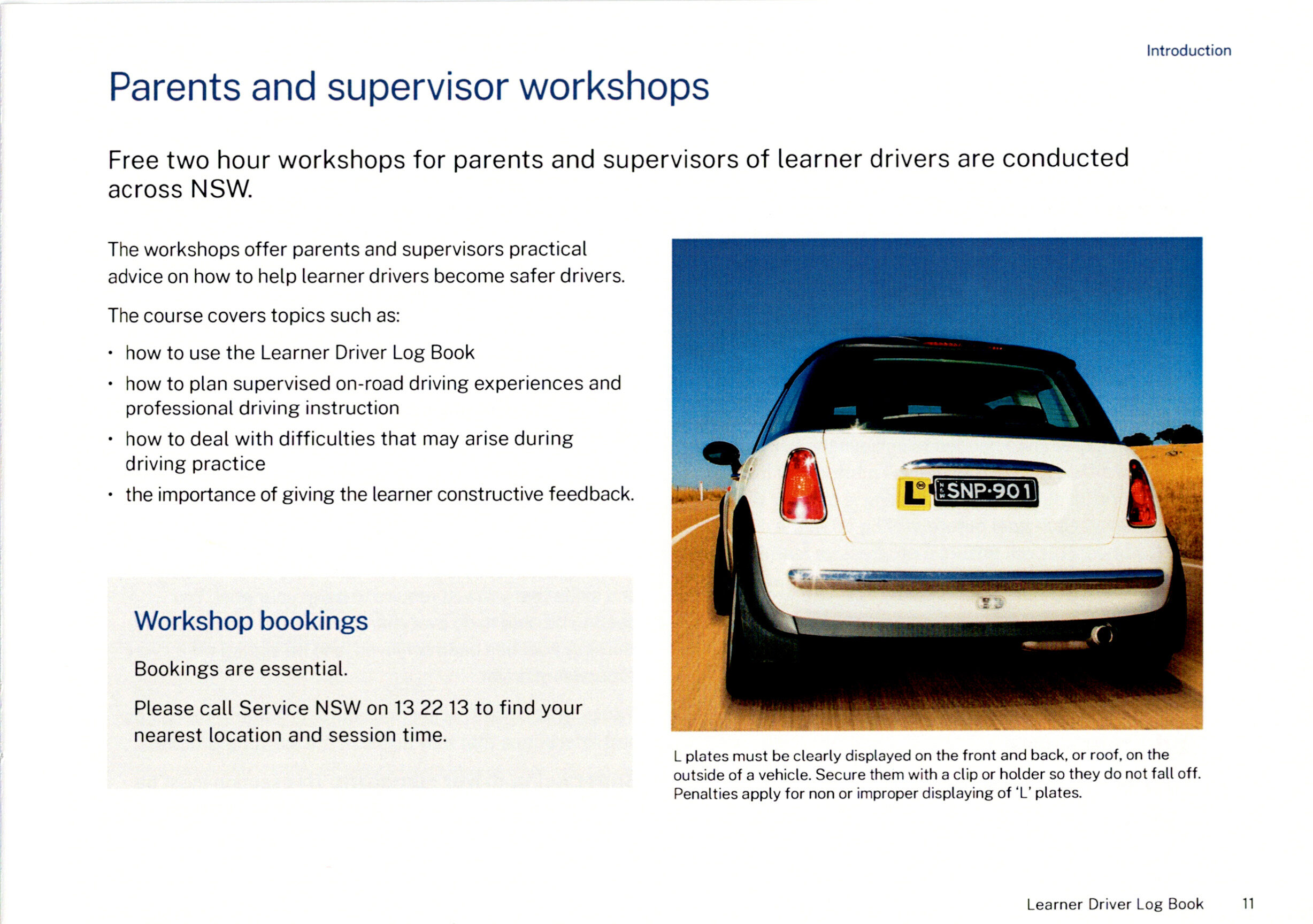
Parents & Supervisor Workshops
Information on free 2-hour coaching workshops conducted across NSW, session booking procedures via Service NSW, and mandatory exterior L-plate display regulations.
Navigating the 20 Learning Goals
How the competency framework is structured across Blue, Red, Purple, and Green skill levels, including progressive learning paths and supervisor sign-off requirements.
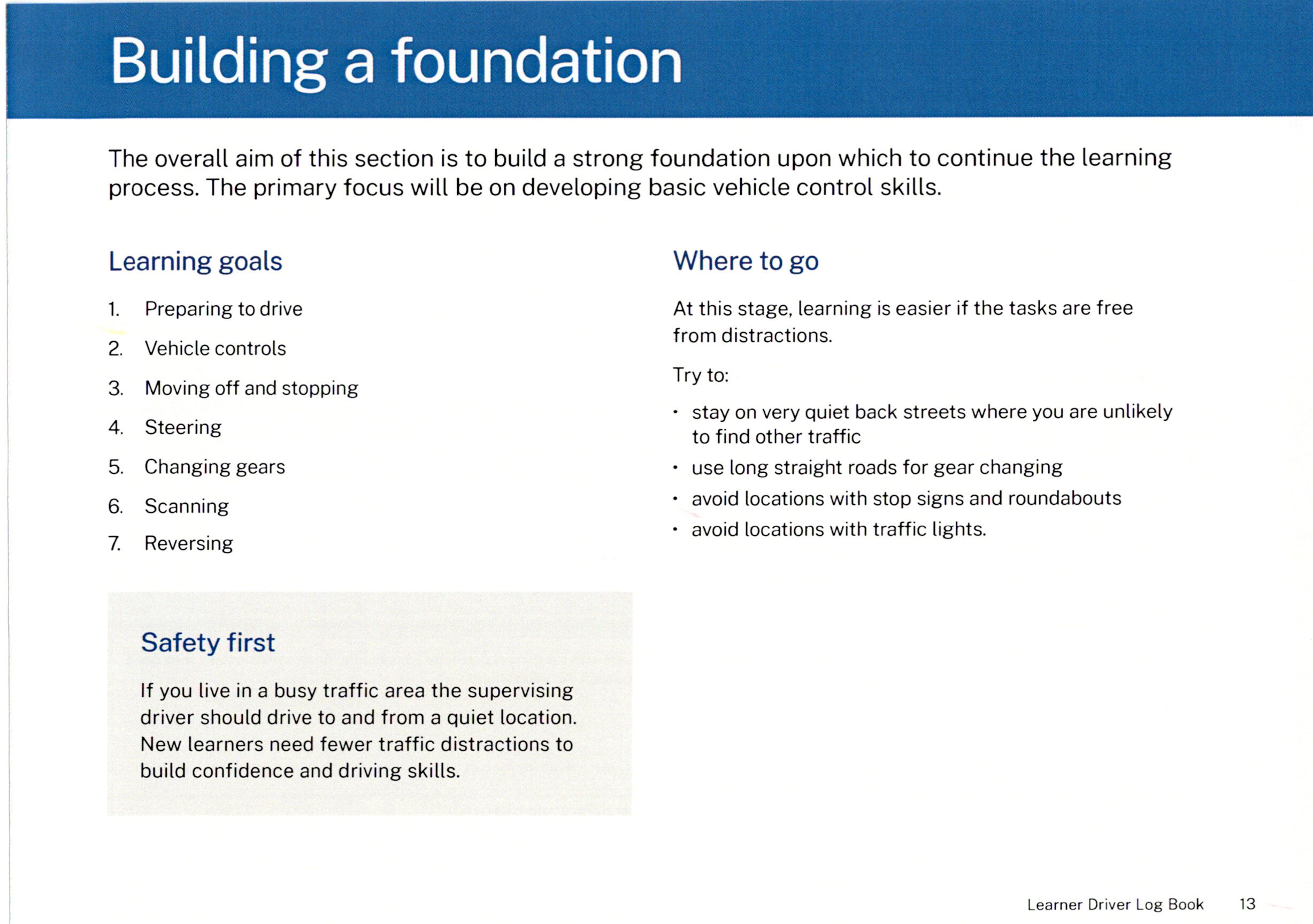
Stage 1: Building a Foundation
Initial vehicle control fundamentals (Goals 1–7), selecting quiet streets without roundabouts or traffic lights, and supervisor swap-over strategies.
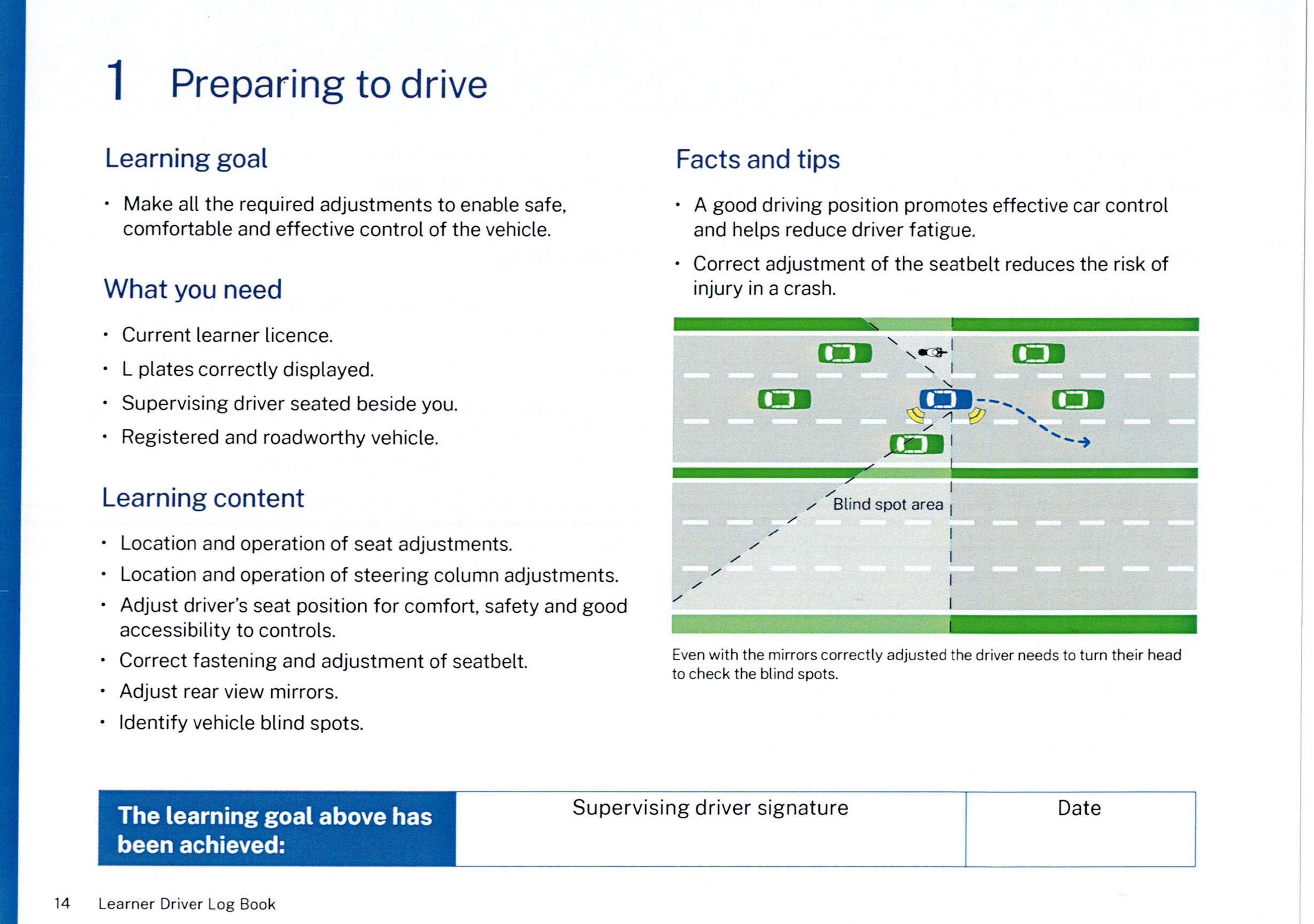
Goal 1: Preparing to Drive
Cockpit adjustment, seating posture, steering column positioning, seatbelt safety, rear-view mirror adjustment, and vehicle blind-spot head checks.
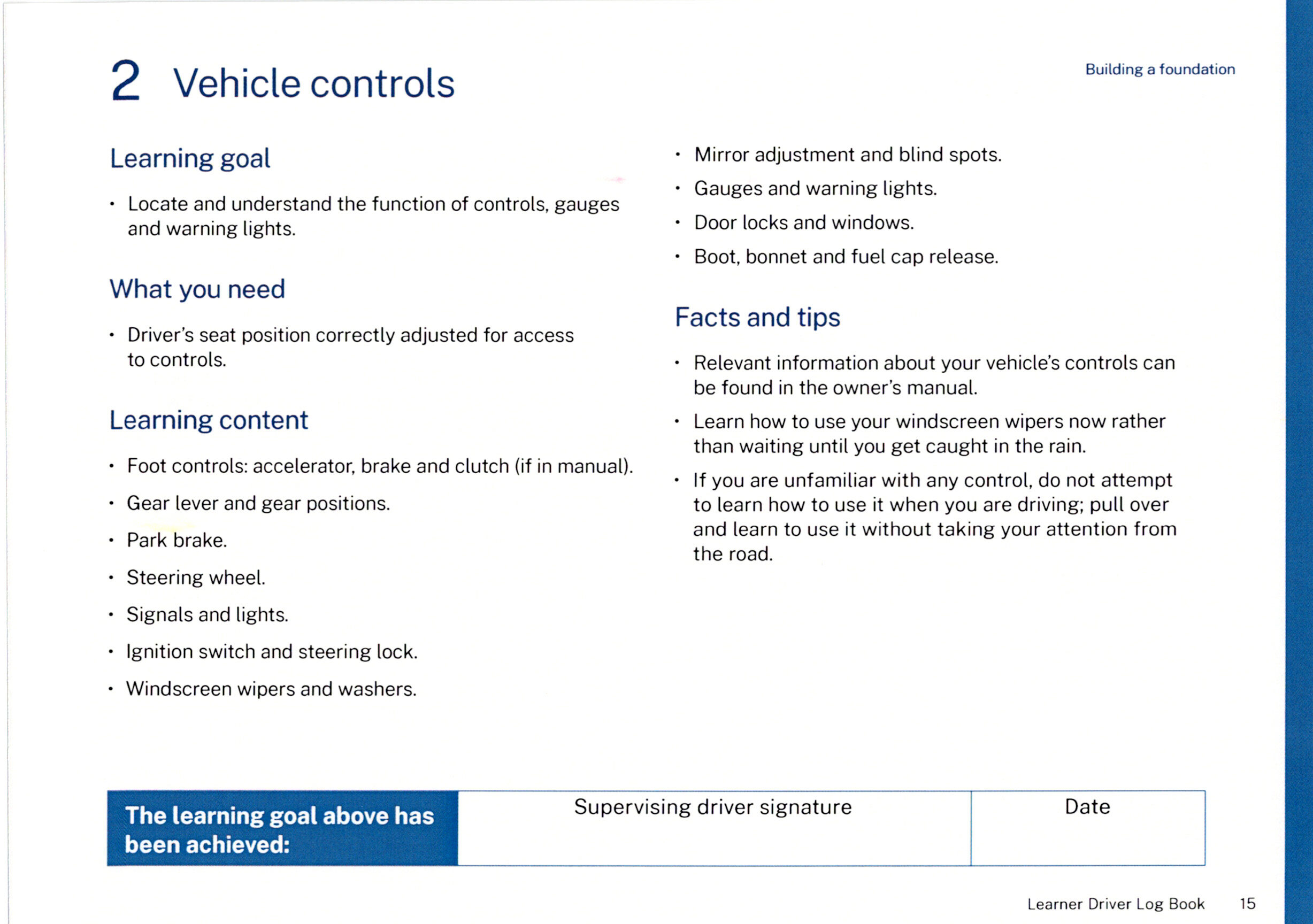
Goal 2: Vehicle Controls
Mastering foot controls (accelerator, brake, clutch), gear levers, park brakes, indicators, steering lock, windscreen wipers, and dashboard warning lamps.
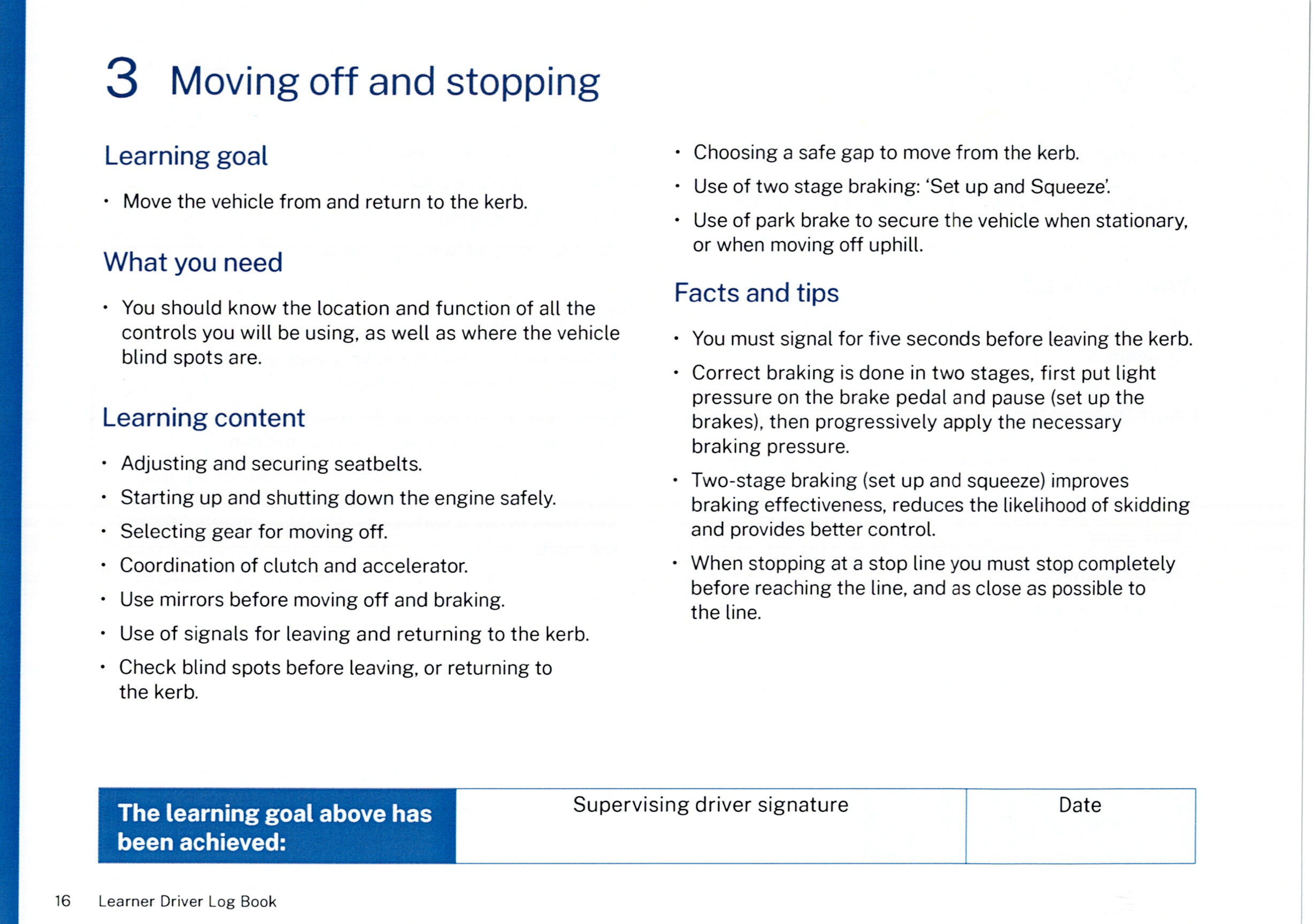
Goal 3: Moving Off & Stopping
Mandatory 5-second indication when departing the kerb, clutch coordination, gap selection, and applying the two-stage 'Set up and Squeeze' braking method.
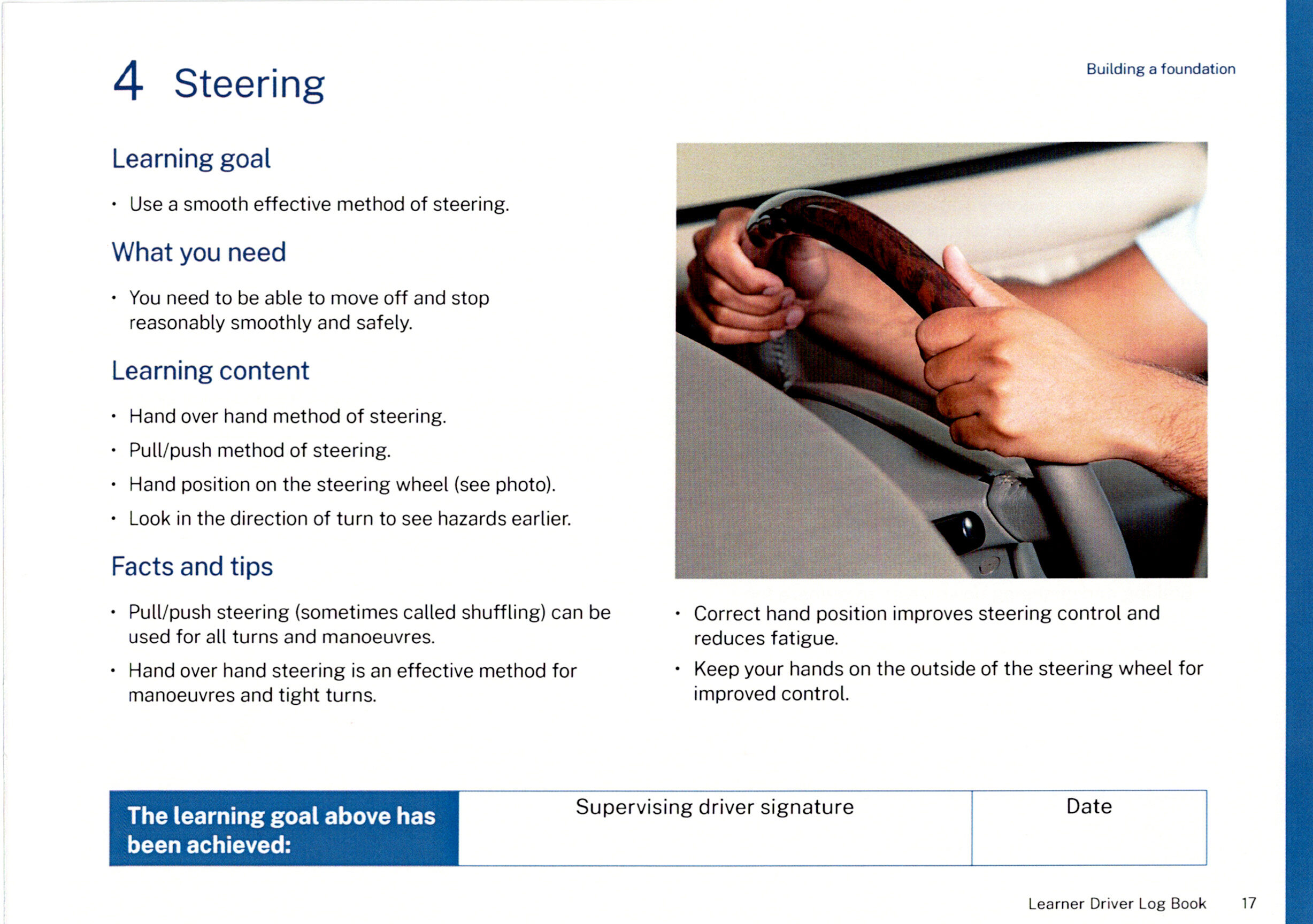
Goal 4: Steering Techniques
Smooth vehicle guidance utilizing hand-over-hand and pull-push (shuffling) techniques, correct outer rim grip, and looking through turns to anticipate hazards.
Goal 5: Changing Gears
Coordination of clutch and gear lever, pausing in neutral, downshifting prior to turns, and using lower ranges (L/S) in automatic transmissions for hill descents.
6. Stage 1: Scanning & Reversing (Goals 6 & 7)
Goal 6: Scanning Techniques
Developing active scanning habits: looking far ahead, monitoring road surfaces for hazards, checking side mirrors regularly, and minimizing in-dash instrument distraction.
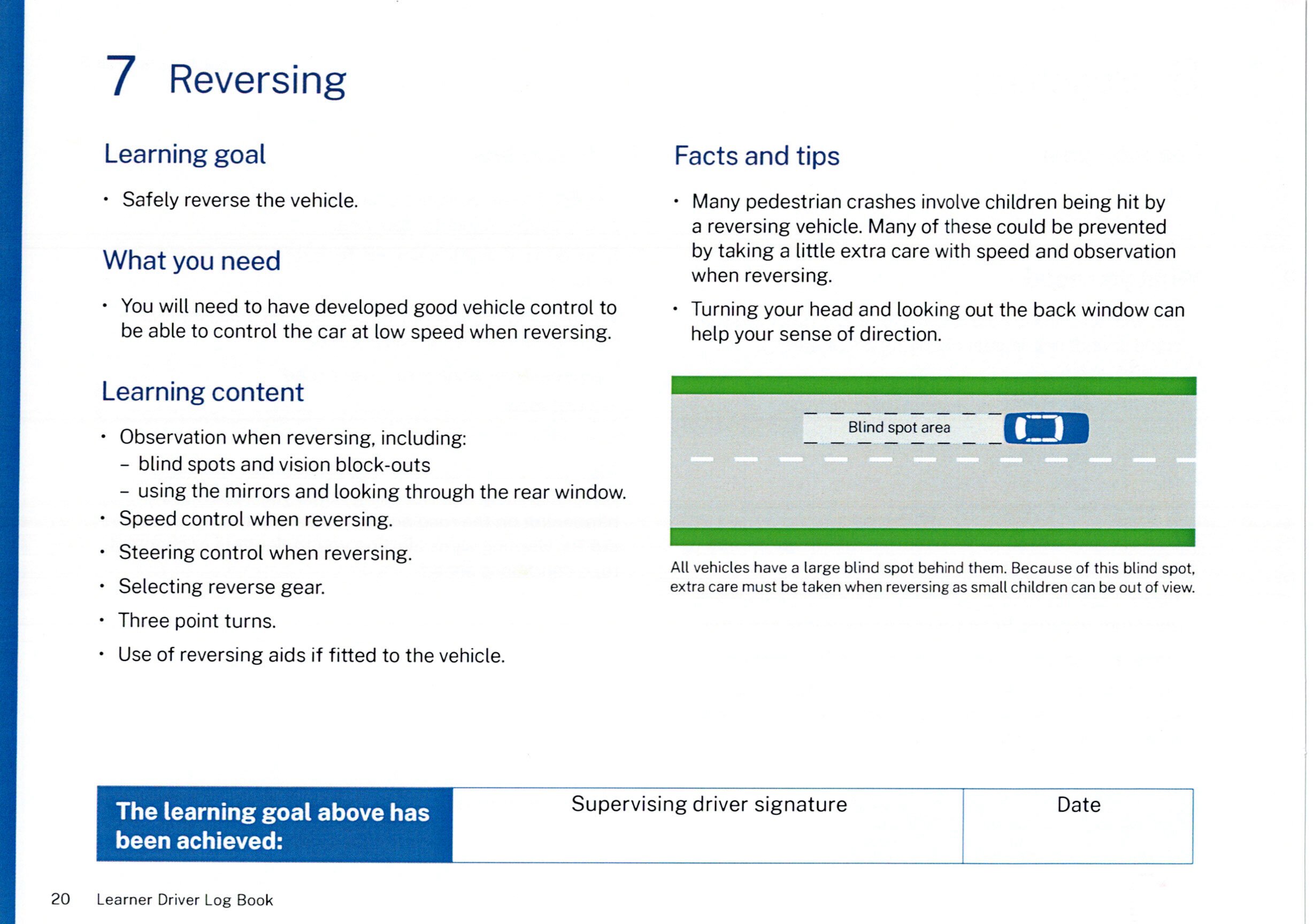
Goal 7: Reversing Manoeuvres
Low-speed precision reversing, checking rear vehicle blind-spot areas, looking out the rear window, and executing controlled three-point turns.
7. Stage 2: Traffic Skills (Goals 8 to 11)
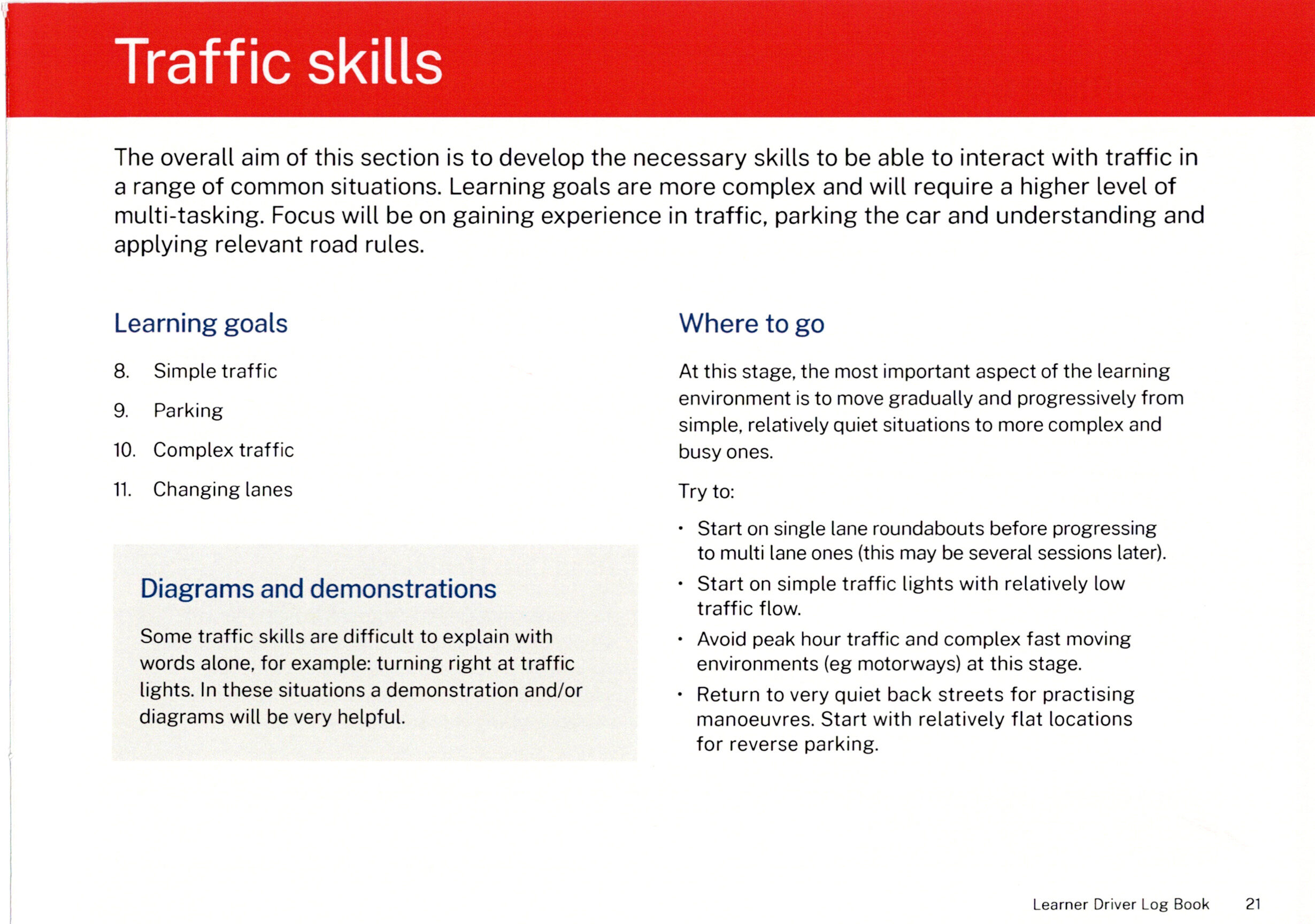
Stage 2: Traffic Skills Overview
Multi-tasking in varied traffic conditions: progressing from quiet streets to single-lane roundabouts, low-traffic signals, and structured parking practice.
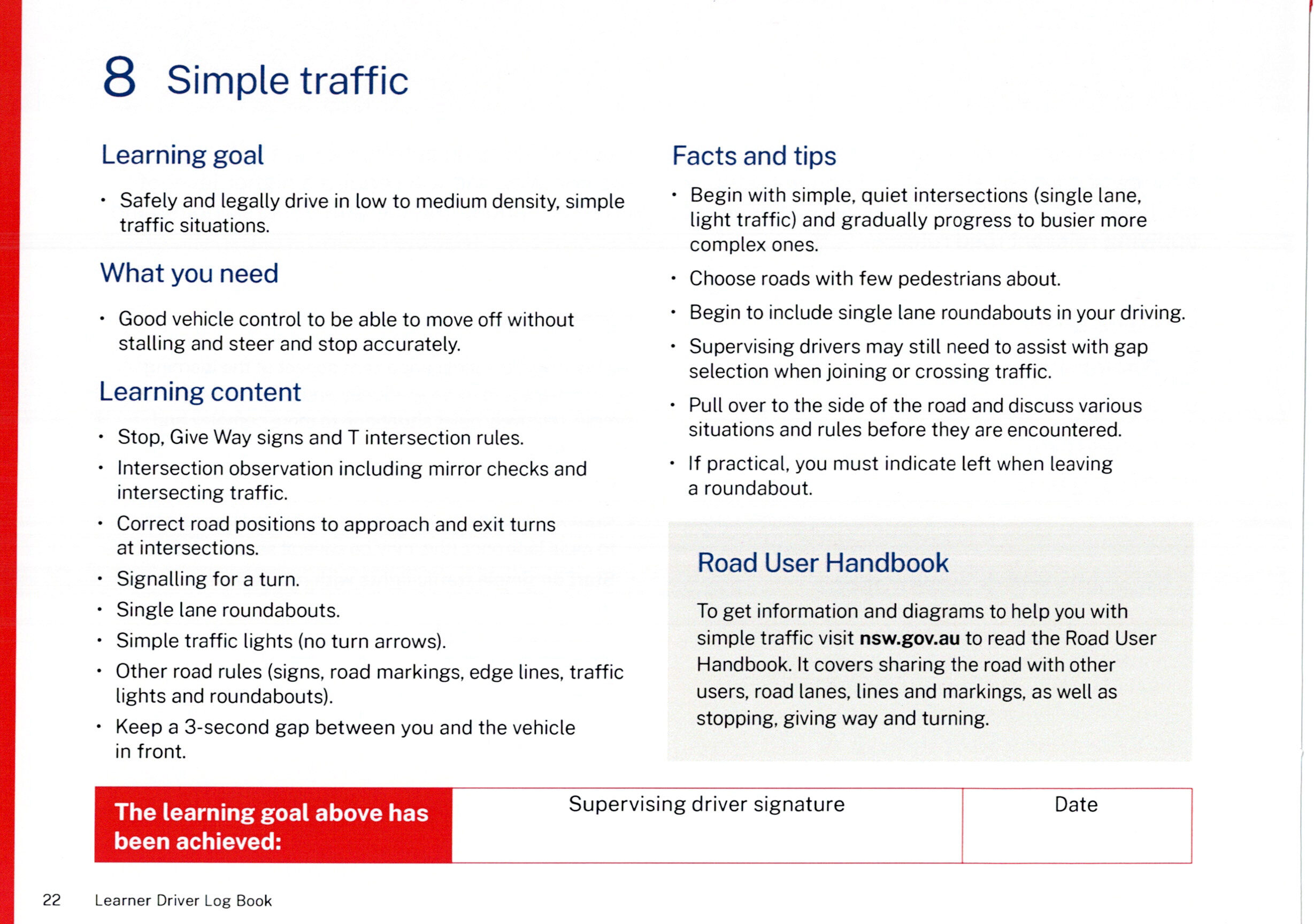
Goal 8: Simple Traffic
Navigating low-to-medium traffic density, obeying Stop and Give Way signs, T-intersection positioning, and maintaining a 3-second following gap.
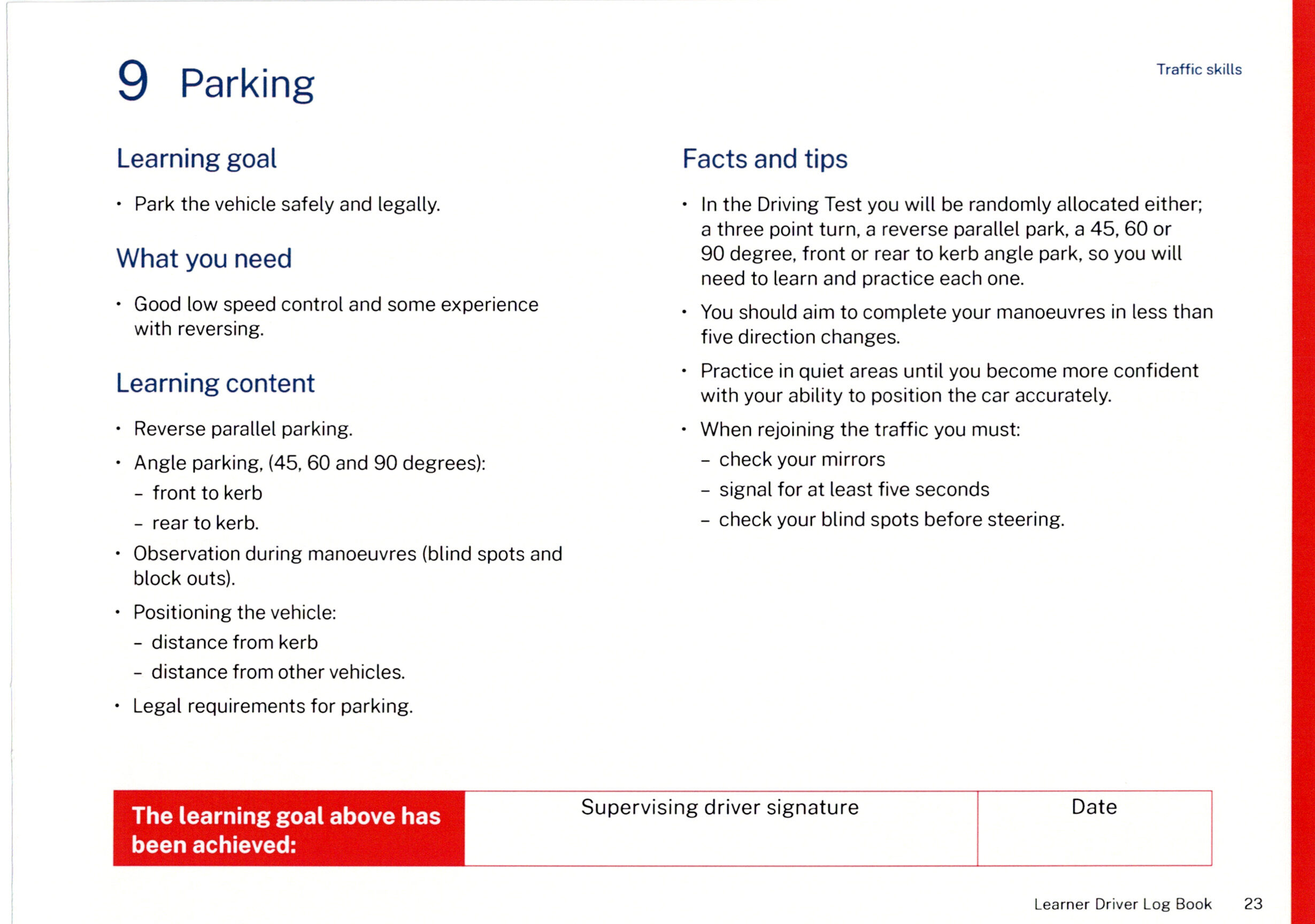
Goal 9: Parking Manoeuvres
Executing reverse parallel and angle parking within 5 direction changes, kerb positioning, and mandatory 5-second indication when rejoining traffic.
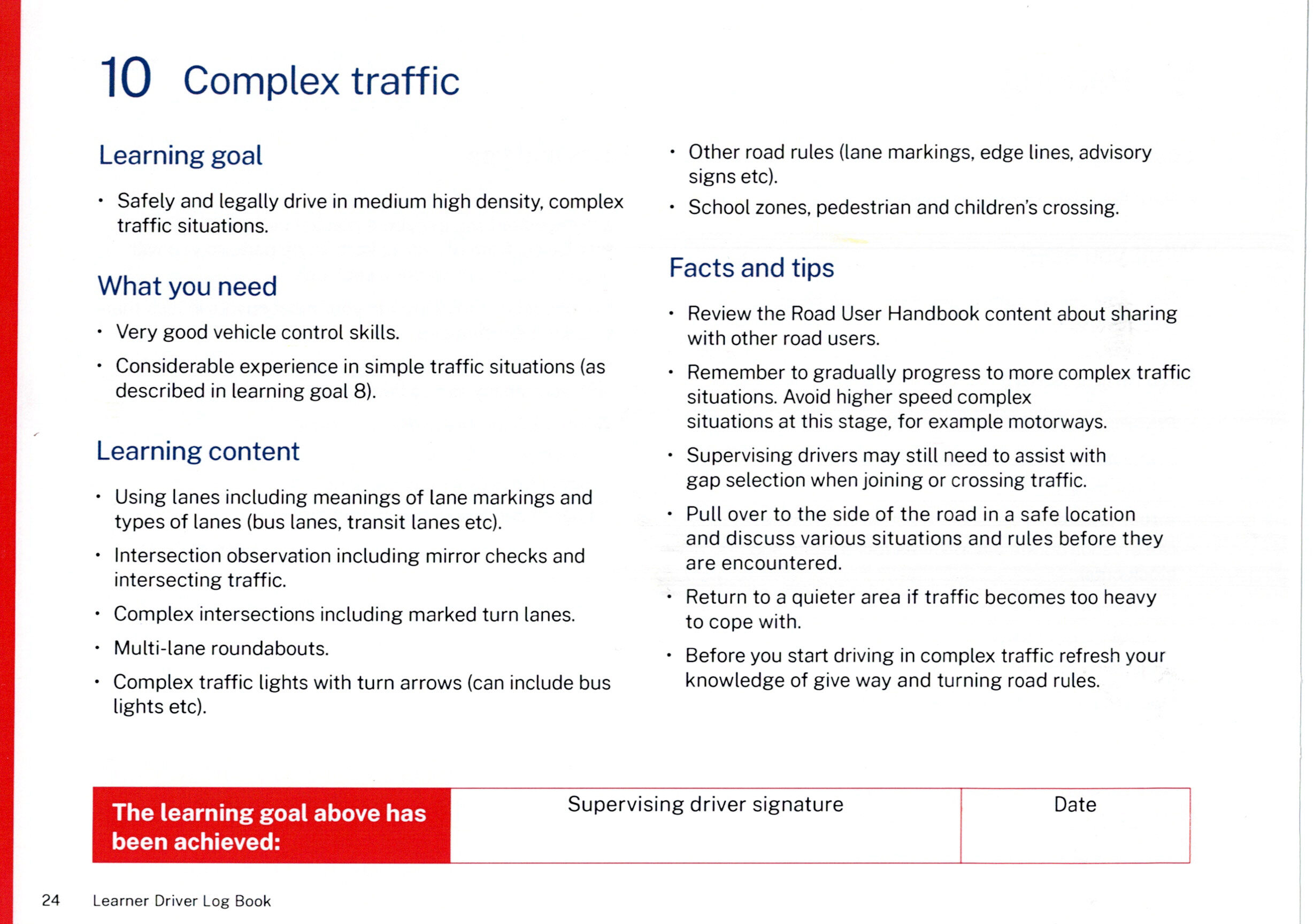
Goal 10: Complex Traffic
Managing medium-to-high traffic density, navigating multi-lane roundabouts, interpreting dedicated turn lanes, complex arrow signals, and school zones.
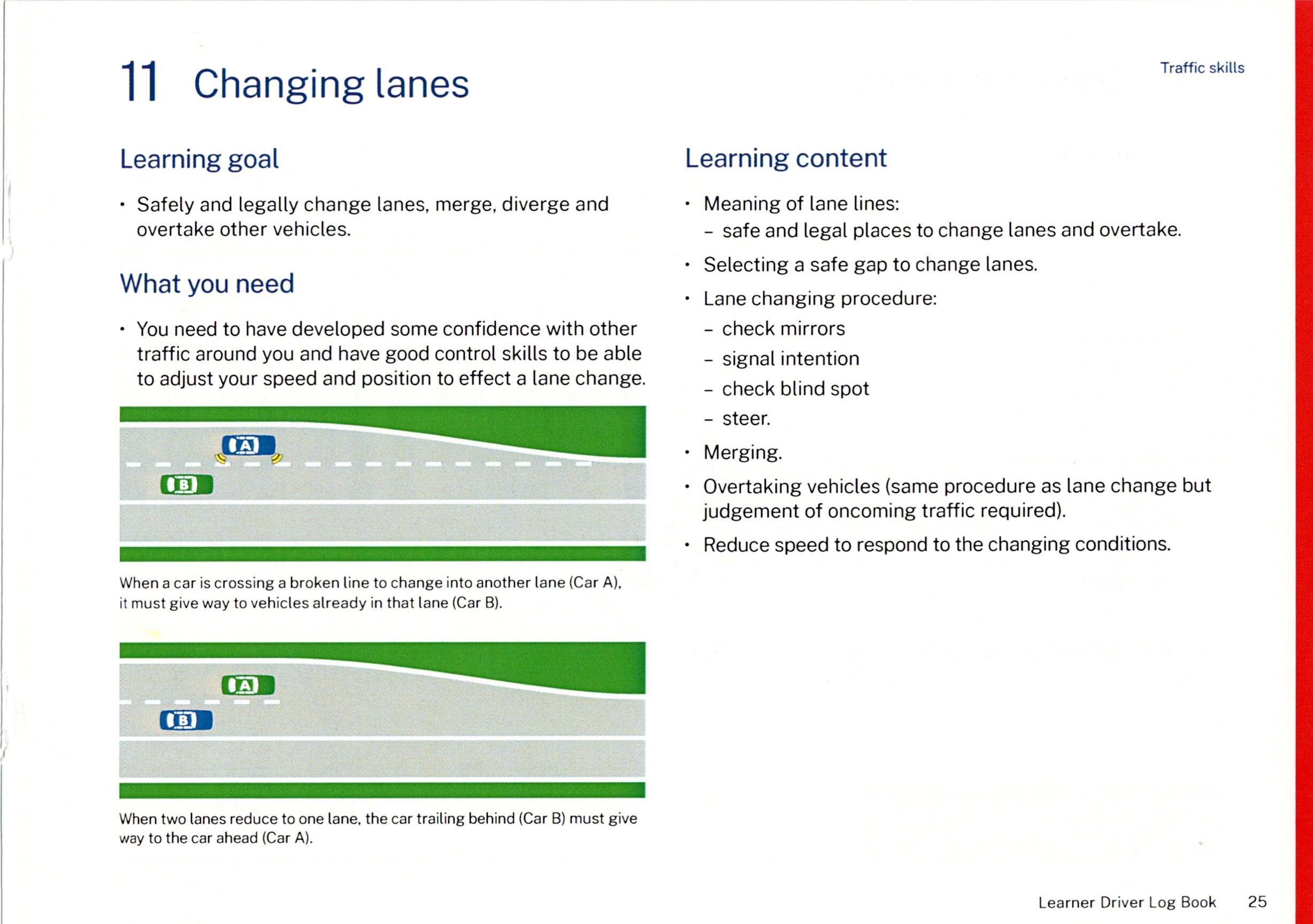
Goal 11: Changing Lanes & Merging
Mirror-signal-blind spot head check routines, selecting safe traffic gaps, broken line rules, and right-of-way obligations when lanes reduce.
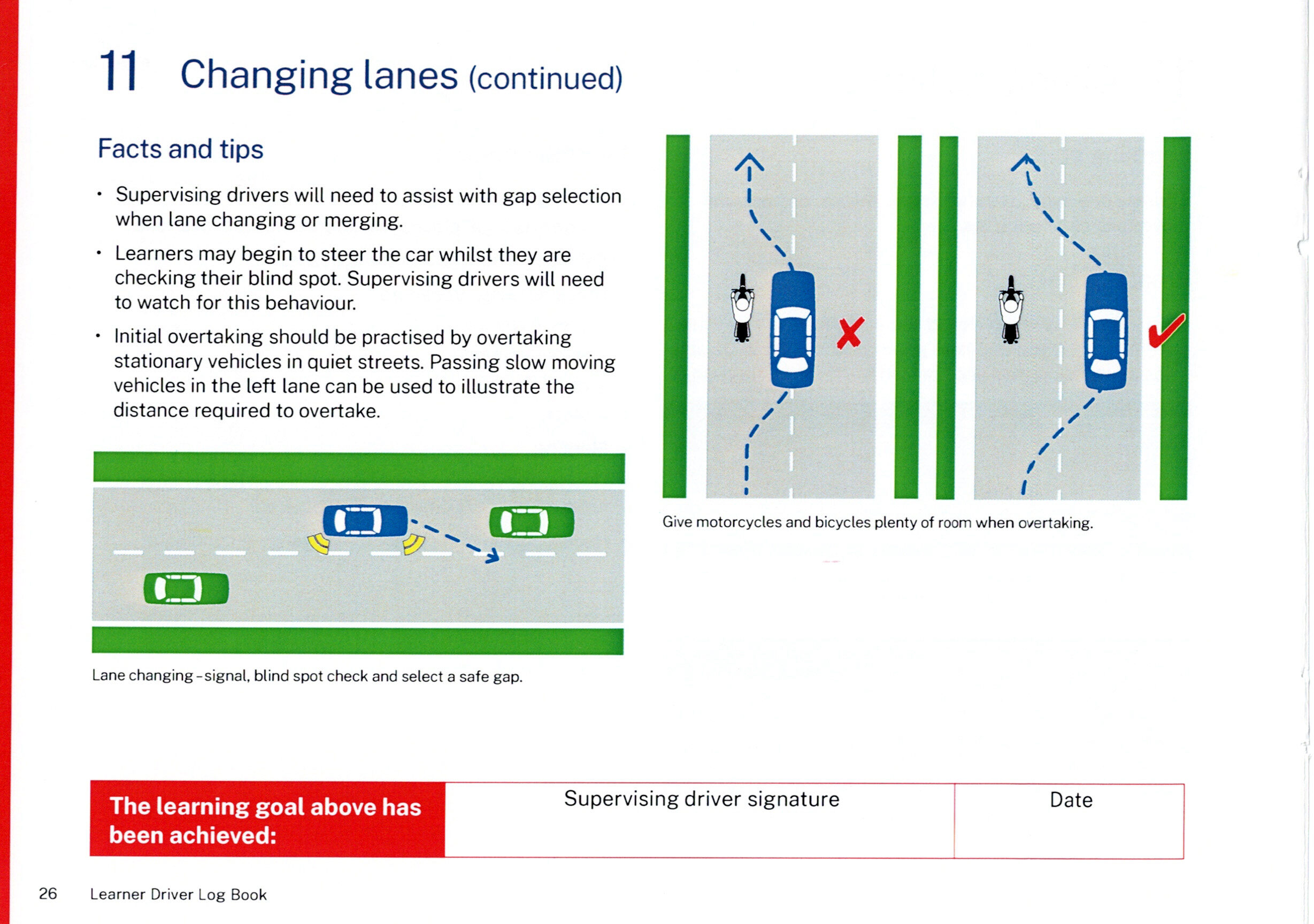
Goal 11: Lane Changing & Overtaking
Supervisor coaching advice: preventing steering drift while head checking, gap selection assistance, and providing safe clearance when passing cyclists.
8. Stage 3: Low-Risk Driving (Overview)
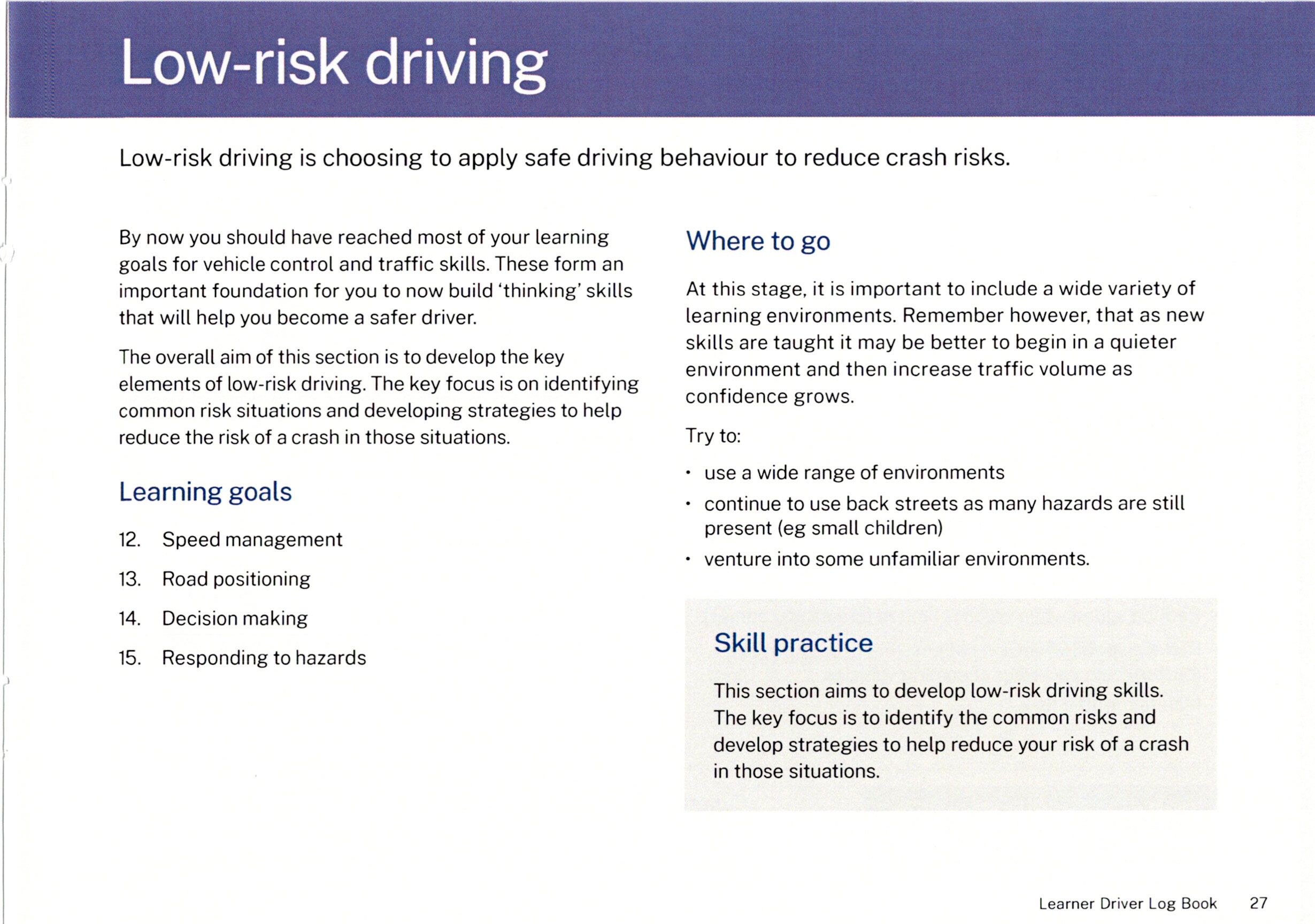
Stage 3: Low-Risk Driving Overview
Transitioning to higher-order cognitive driving skills: speed management, road positioning, decision-making, and responding proactively to road hazards.
9. Stage 3: Low-Risk Driving (Goals 12 to 15)
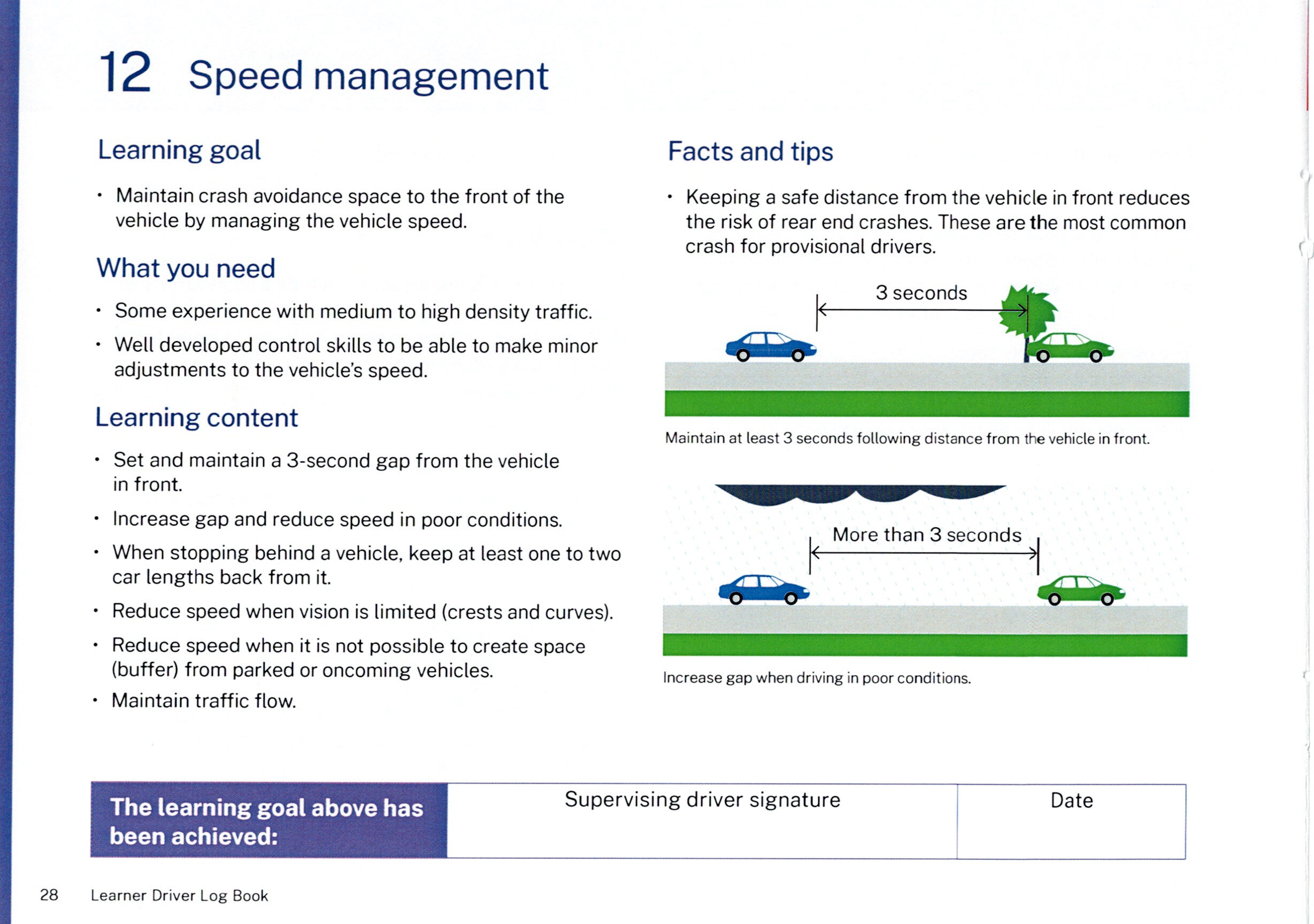
Goal 12: Speed Management
Maintaining front crash avoidance space: establishing a 3-second following gap, extending space in poor conditions, and leaving two vehicle lengths when queued.
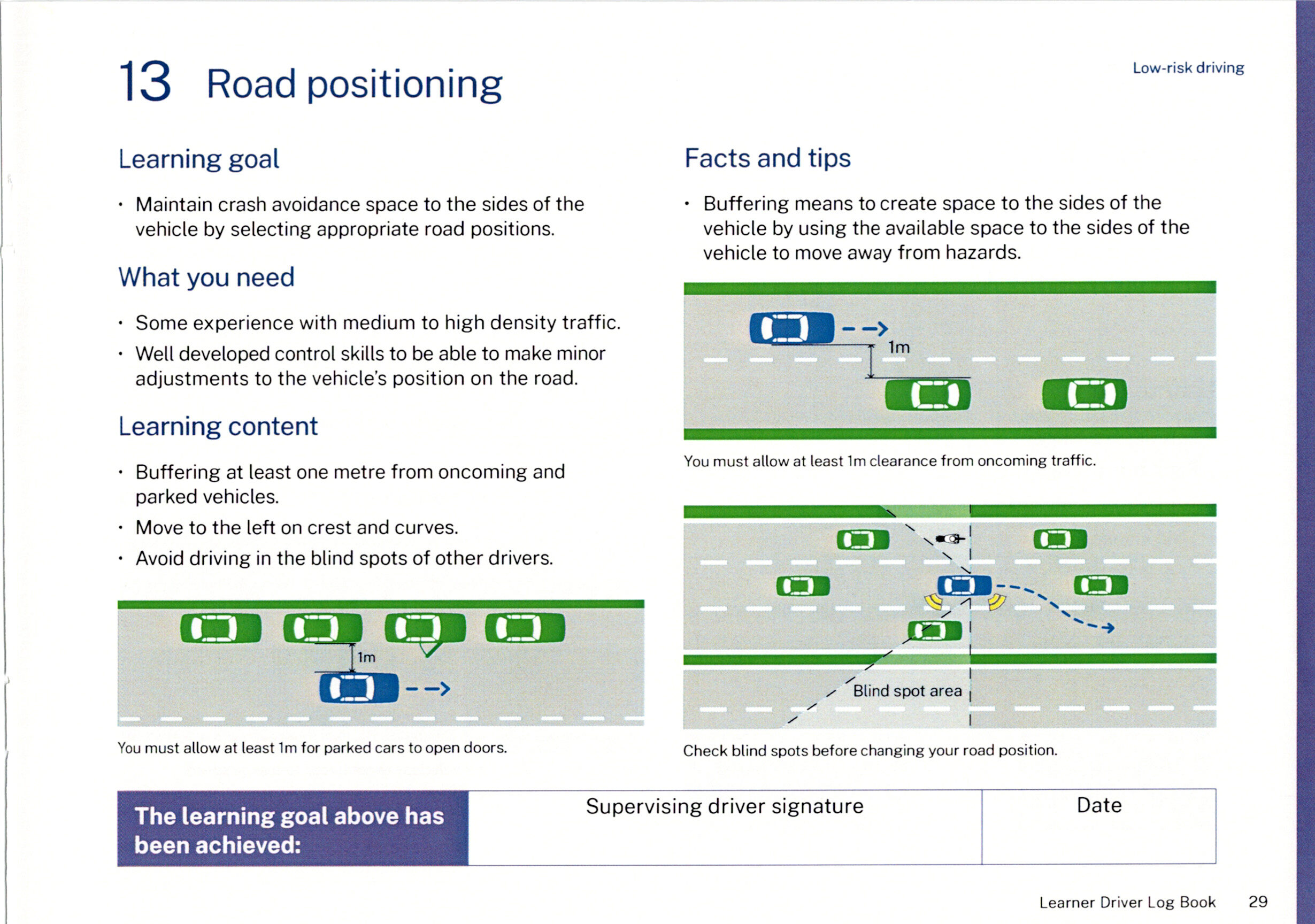
Goal 13: Road Positioning
Side crash avoidance buffering: maintaining at least 1-metre lateral clearance from oncoming traffic and parked car doors, and tracking left over crests.
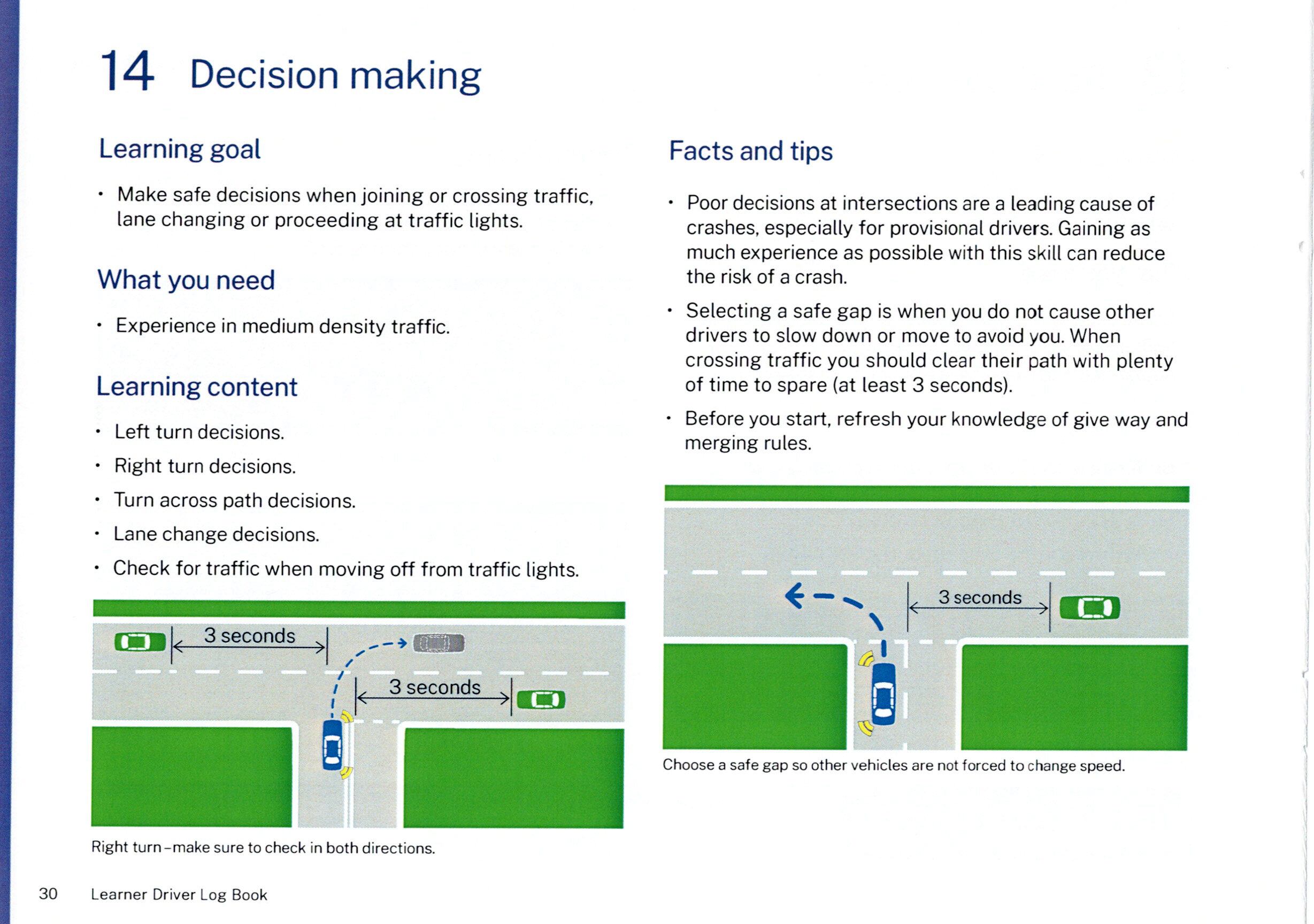
Goal 14: Decision Making (Part 1)
Gap selection at intersections: judging safe 3-second entry gaps without forcing other traffic to brake or swerve when turning or crossing roads.
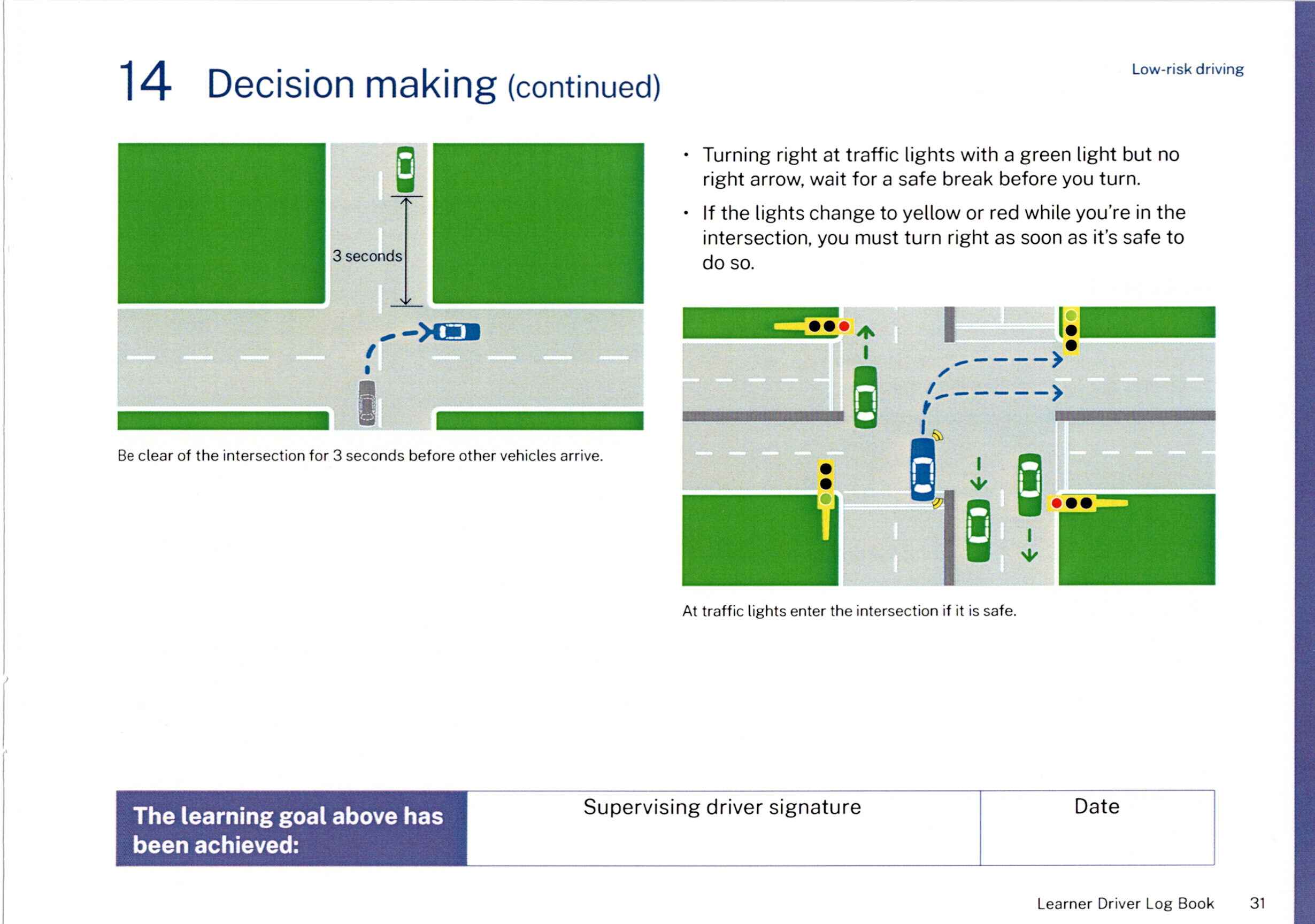
Goal 14: Decision Making (Part 2)
Right-turn intersection routines: waiting past the stop line on green without filter arrows, and completing clearance safely if signals change.
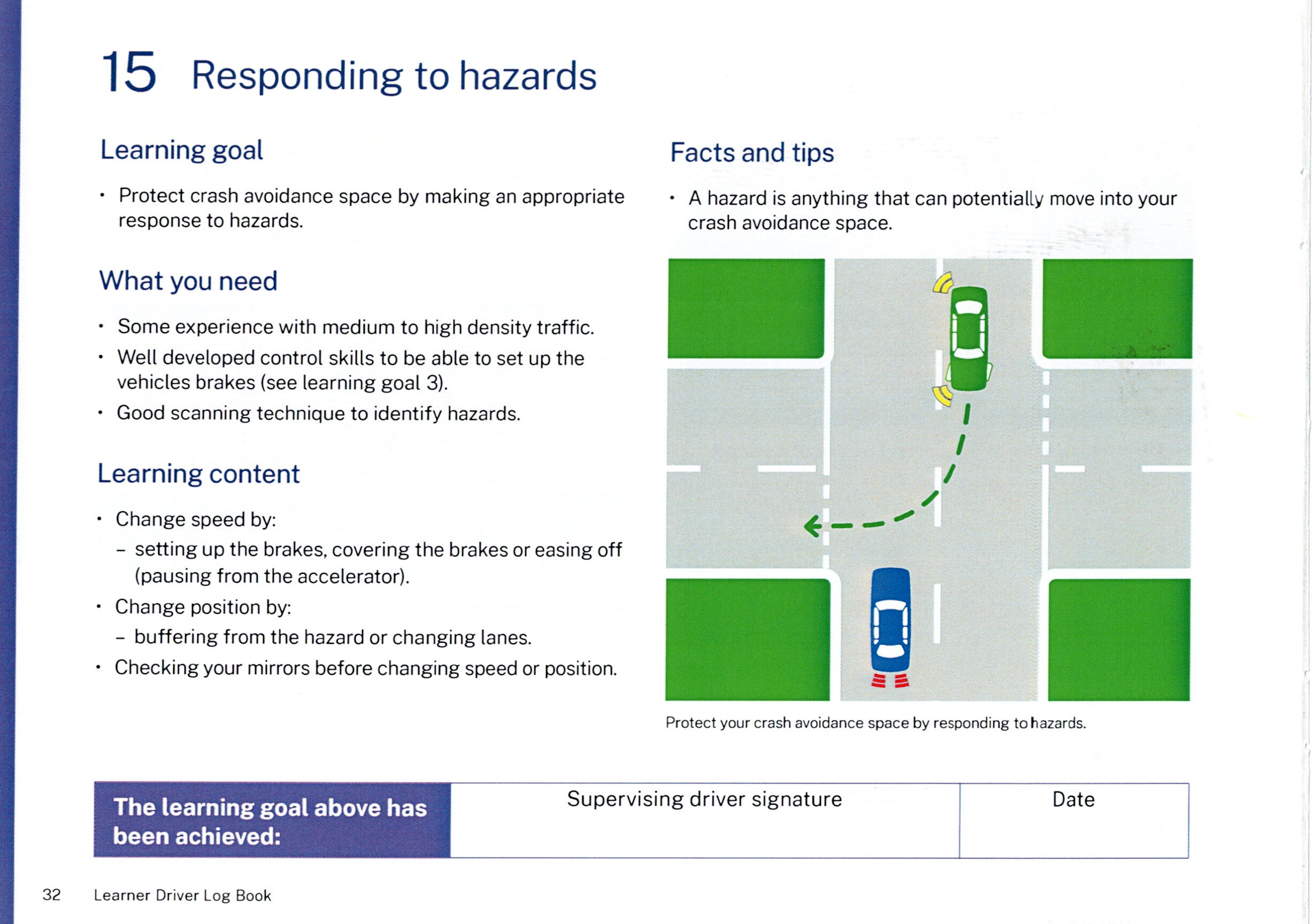
Goal 15: Responding to Hazards
Proactive hazard response: easing off the accelerator, setting up the brakes early, repositioning away from potential conflict points, and checking mirrors.
10. Stage 4: Gaining Experience (Goals 16 to 18)
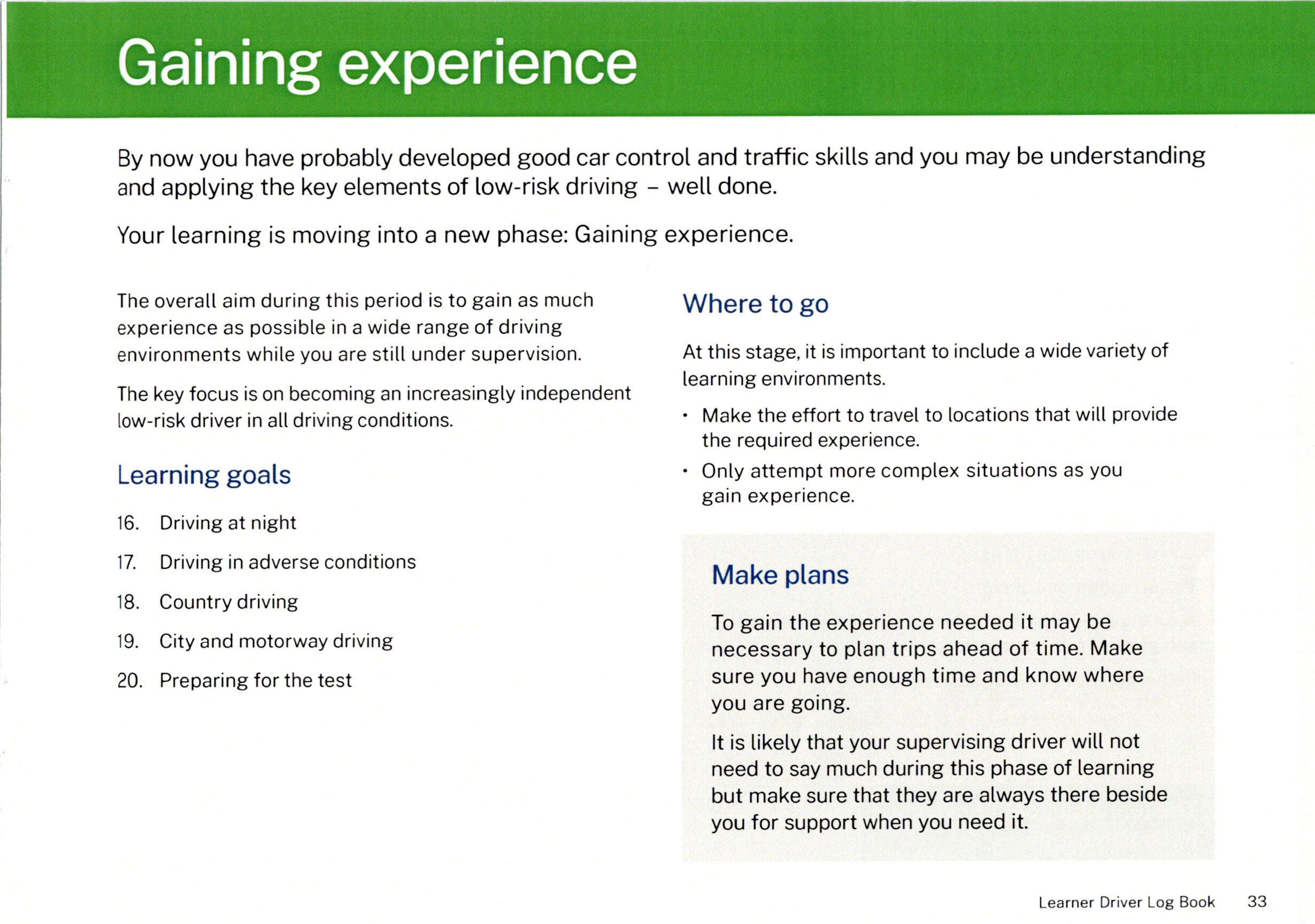
Stage 4: Gaining Experience Overview
Transitioning to independent driving: planning diverse trip routes and reducing supervisor verbal intervention as autonomous skill develops.
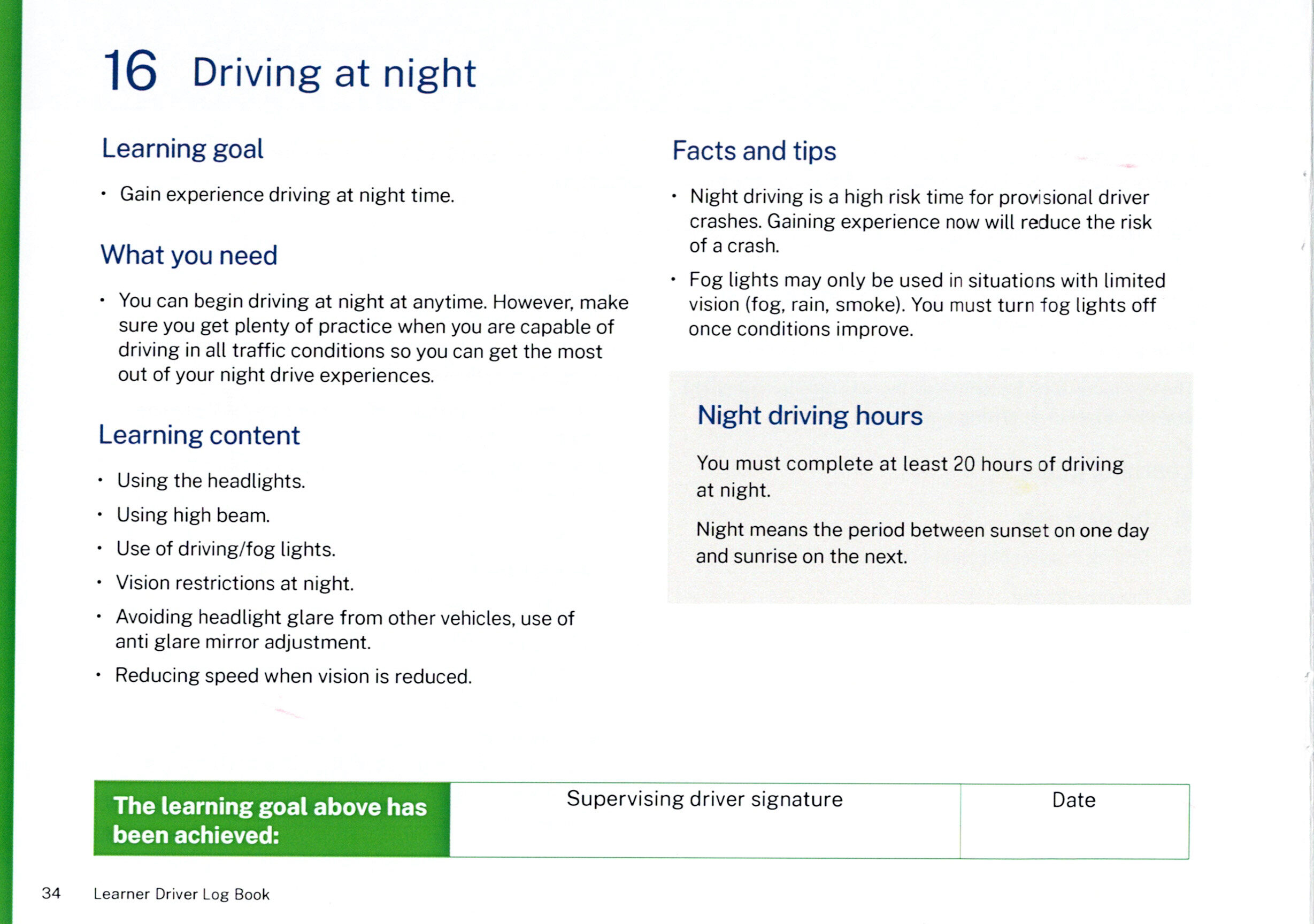
Goal 16: Driving at Night
Fulfilling the 20 mandatory night hours: using high beam correctly, dipping headlights, anti-glare mirror adjustments, and managing reduced contrast.
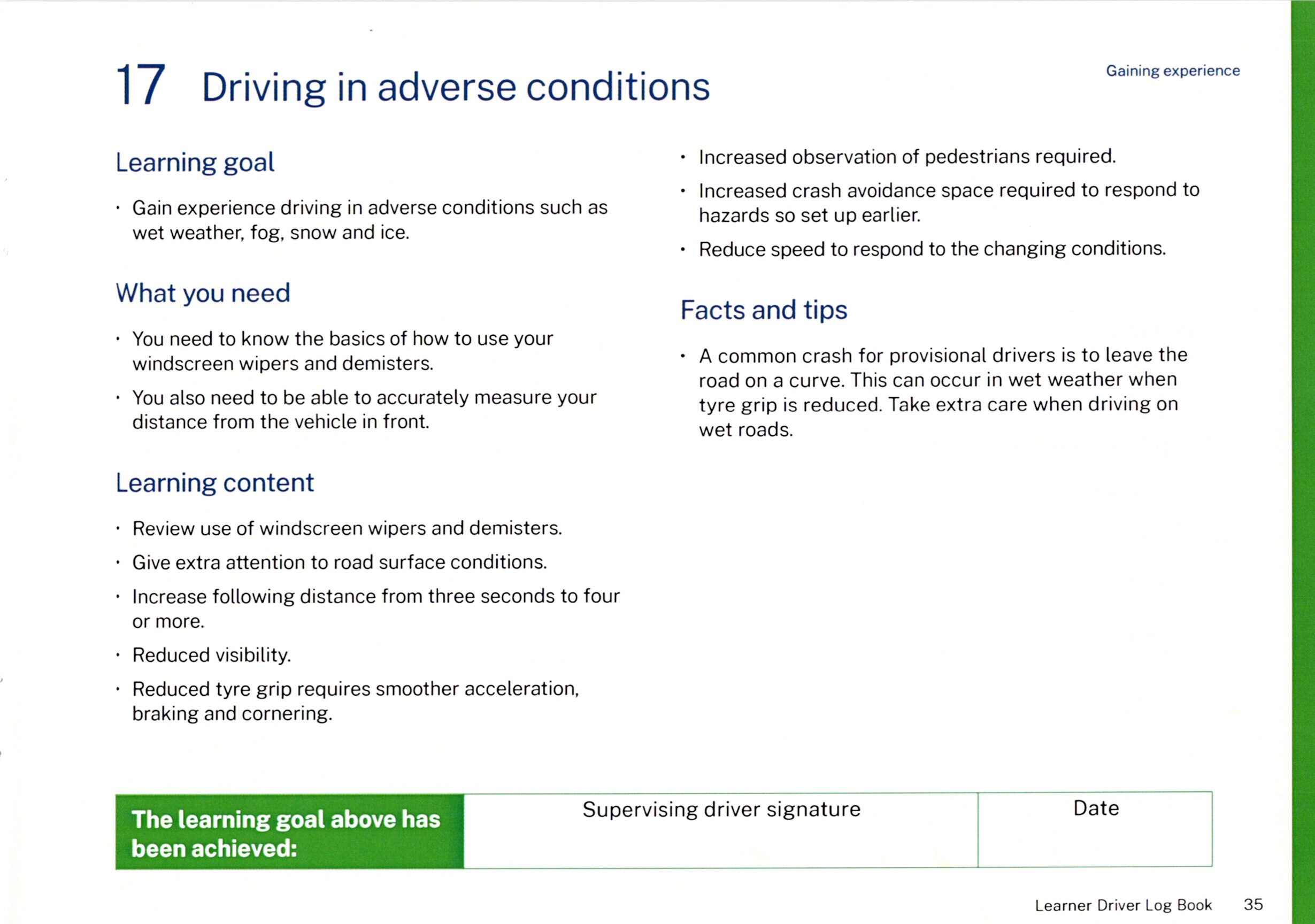
Goal 17: Driving in Adverse Conditions
Wet weather, fog, and ice management: windscreen demisting, smooth acceleration and braking, and extending crash avoidance space to 4+ seconds.
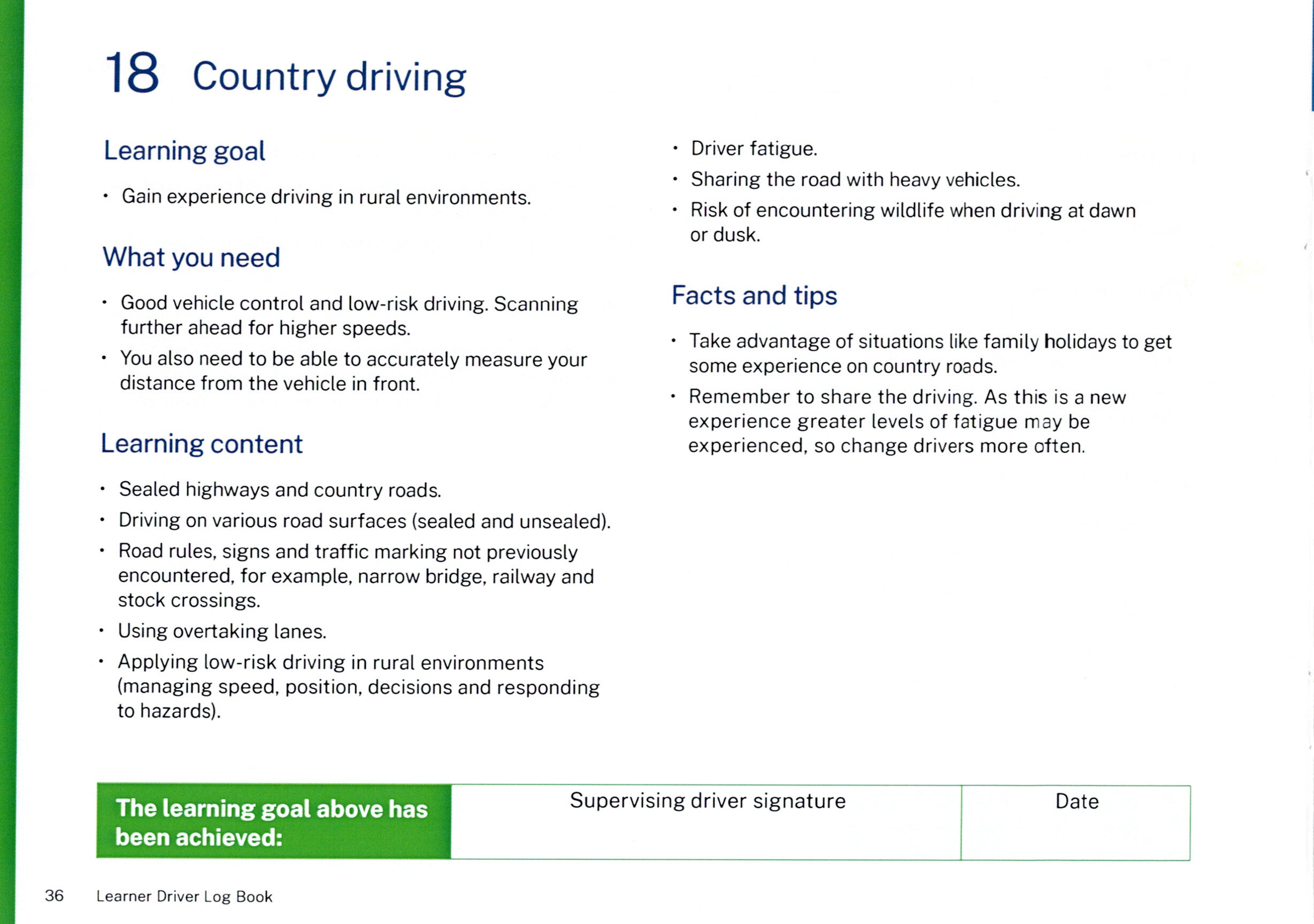
Goal 18: Country Driving
Rural highway driving: handling gravel and unsealed roads, managing fatigue on long stretches, using overtaking lanes, and wildlife vigilance.
11. Stage 4: Motorway Driving & Test Preparation (Goals 19 & 20)
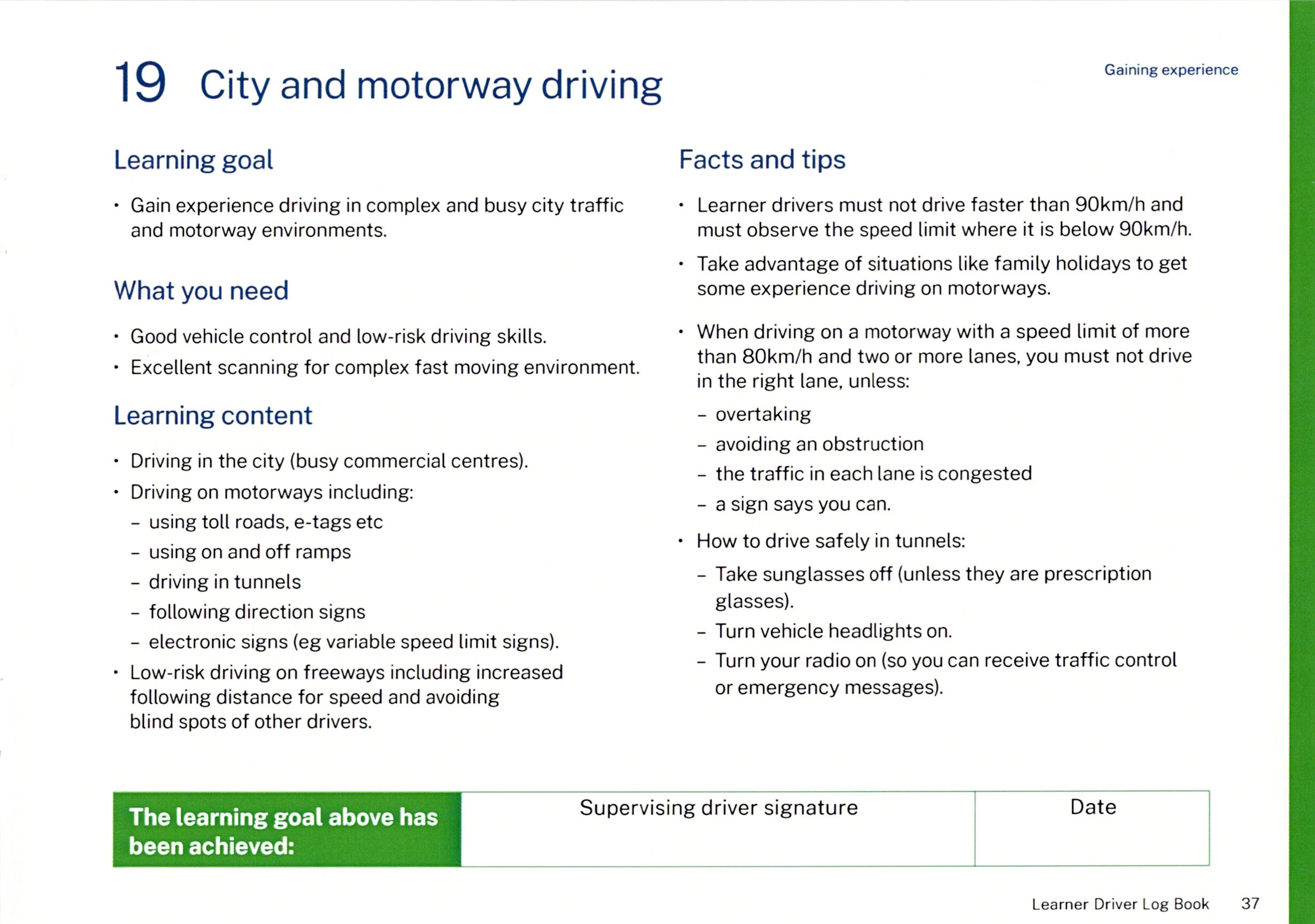
Goal 19: City & Motorway Driving
High-speed multilane roads: learner 90 km/h speed limits, keep-left rules on roads over 80 km/h, on/off ramps, variable speed signs, and tunnel safety.
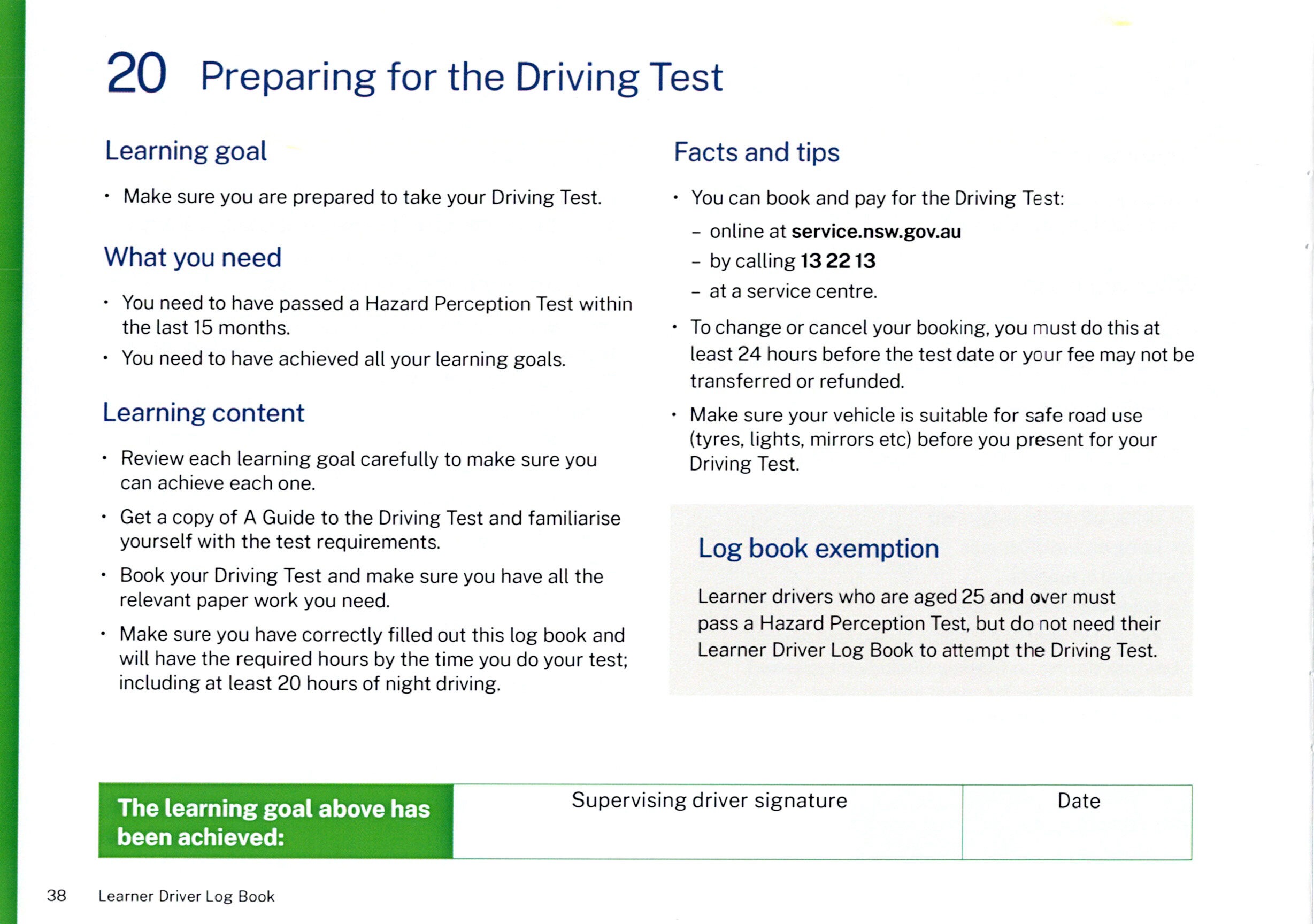
Goal 20: Preparing for the Driving Test
Practical test readiness: booking via Service NSW, vehicle roadworthiness criteria (tyres, lights, mirrors), HPT validity (15 months), and 25+ age exemptions.
12. Recording Driving Experience Hours
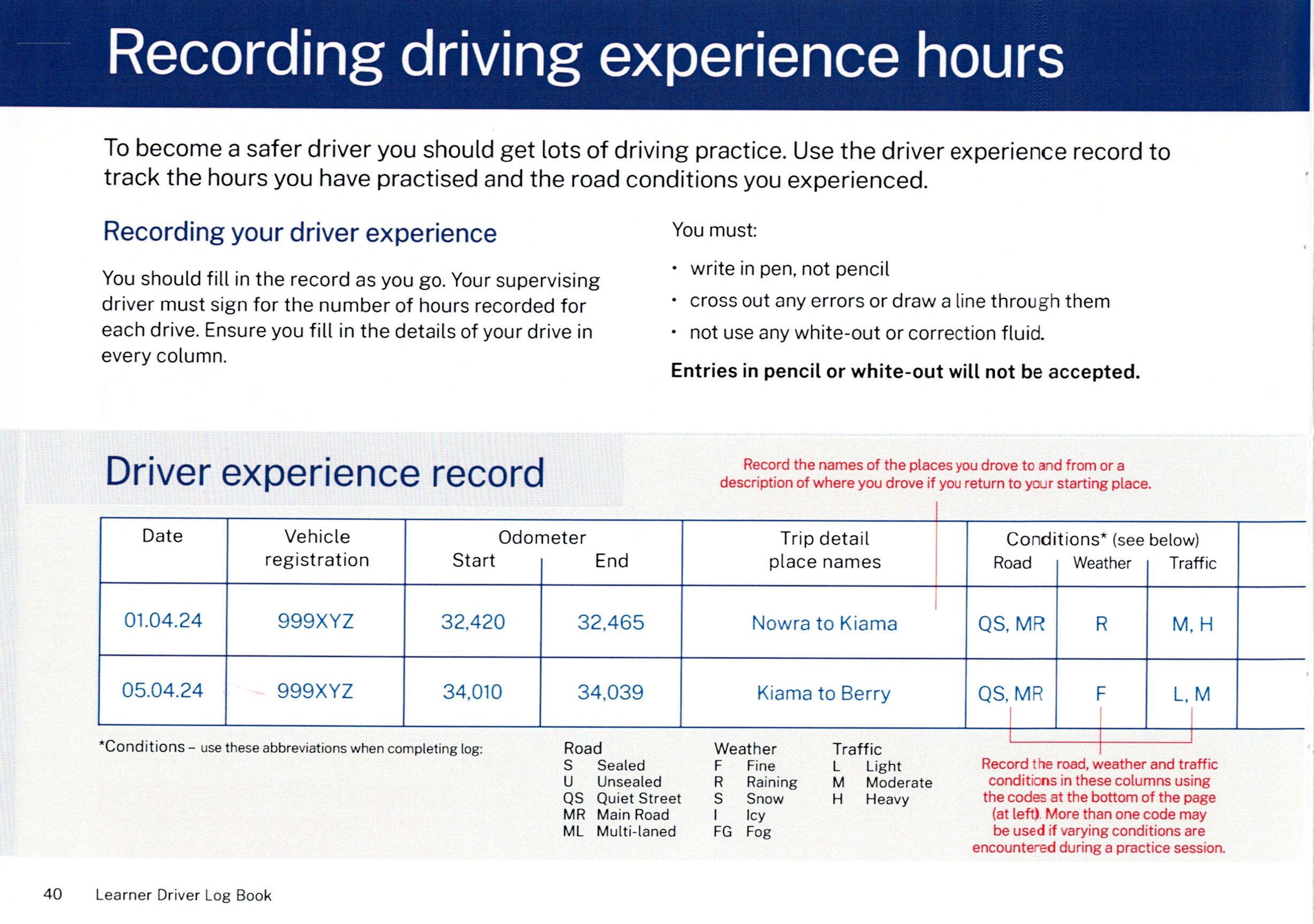
Experience Record Guidelines
Mandatory logging standards: recording entries in pen, crossing out errors without correction fluid, and using standard abbreviations for road, weather, and traffic.
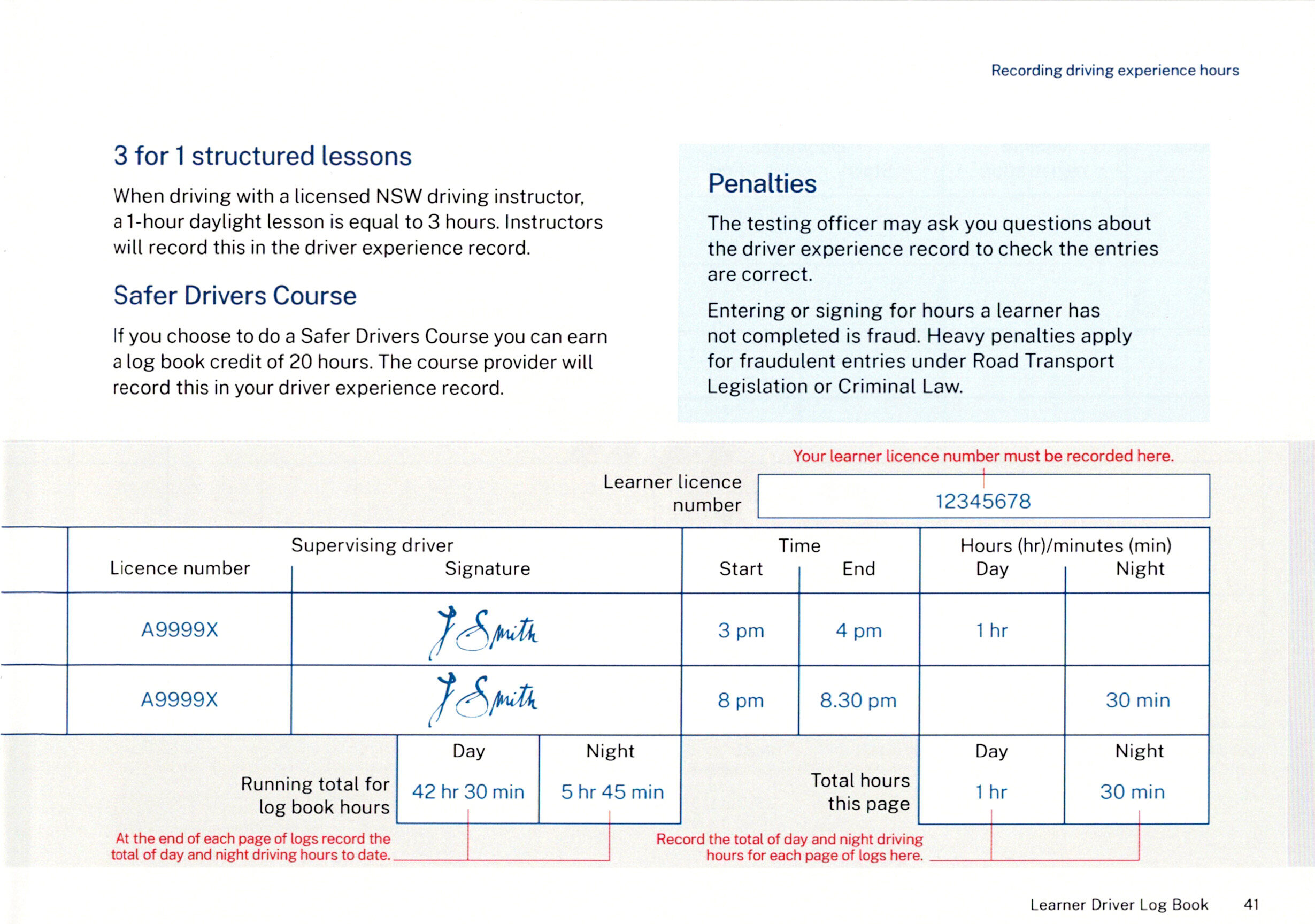
3-for-1 Logging & Fraud Penalties
Instructor 3-for-1 log examples, Safer Drivers Course 20-hour credits, cumulative day/night calculations, and legal penalties for fraudulent log entries.
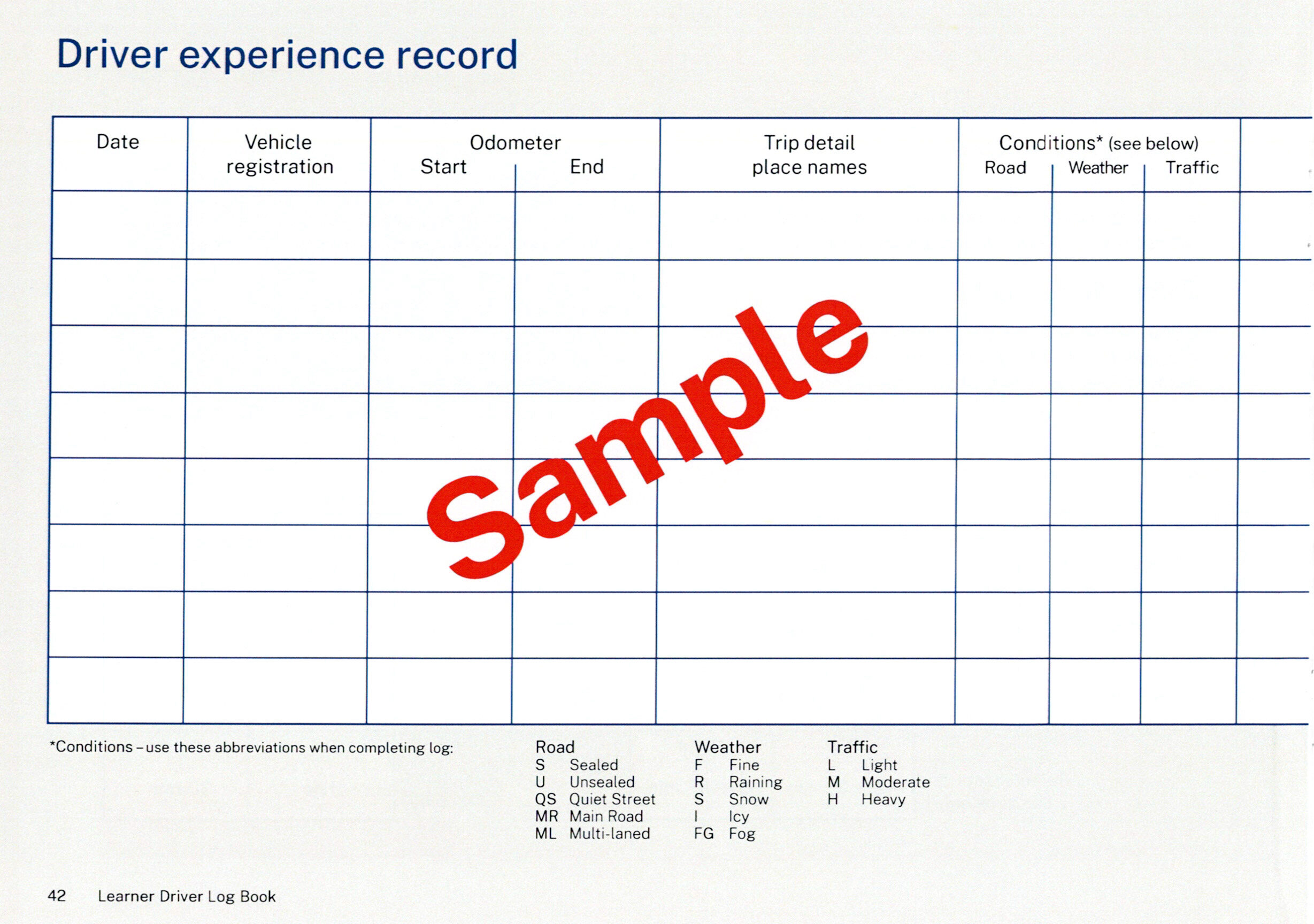
Log Sheet: Trip Details & Odometer
Statutory entry layout: capturing session dates, registration plate numbers, start/finish odometer figures, route destinations, and driving conditions.
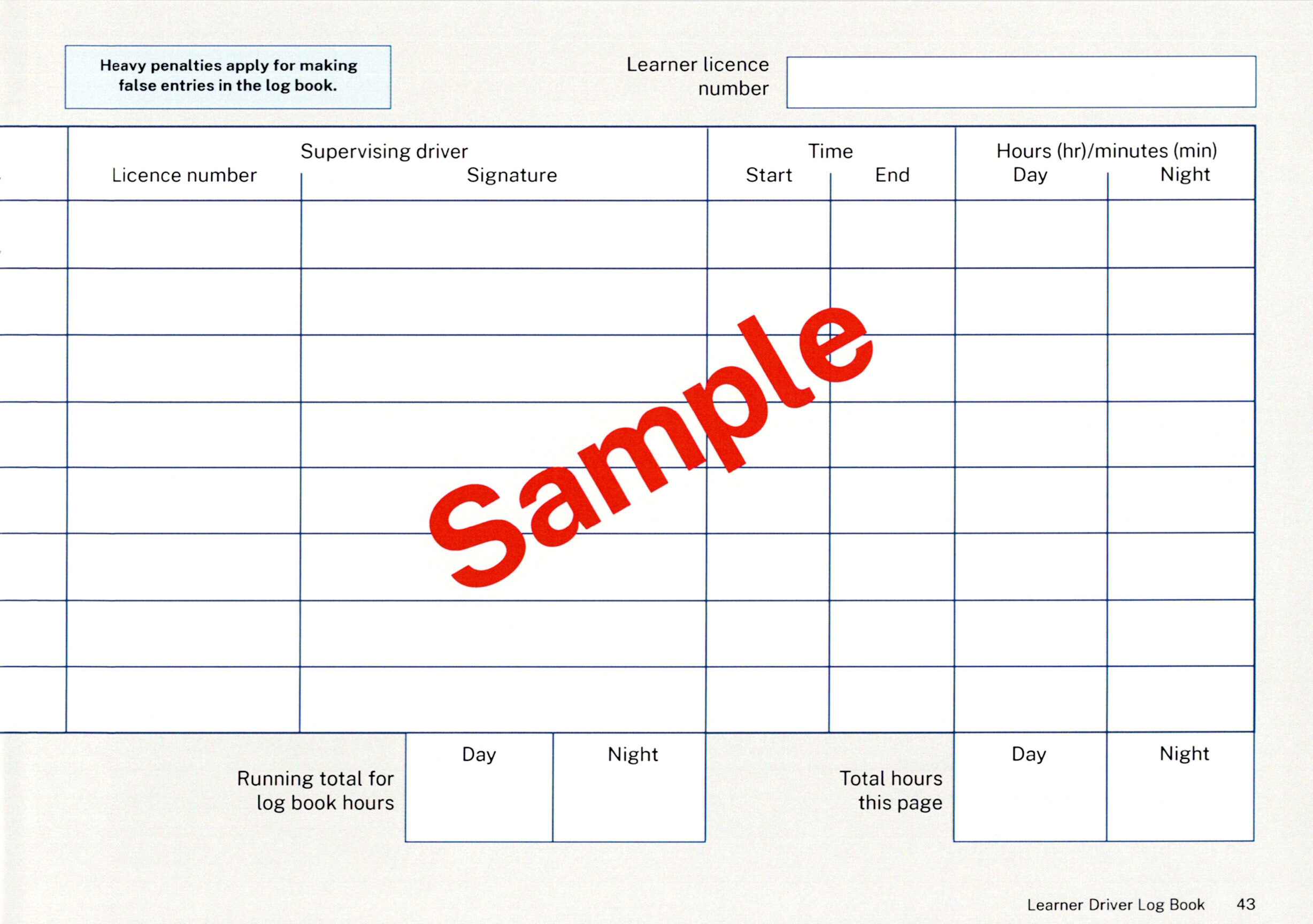
Log Sheet: Signatures & Hour Totals
Supervisory verification: supervisor driver licence numbers, signatures, exact start/end times, individual page tallies, and running log totals.
13. Test Readiness Checklist & Final Declaration
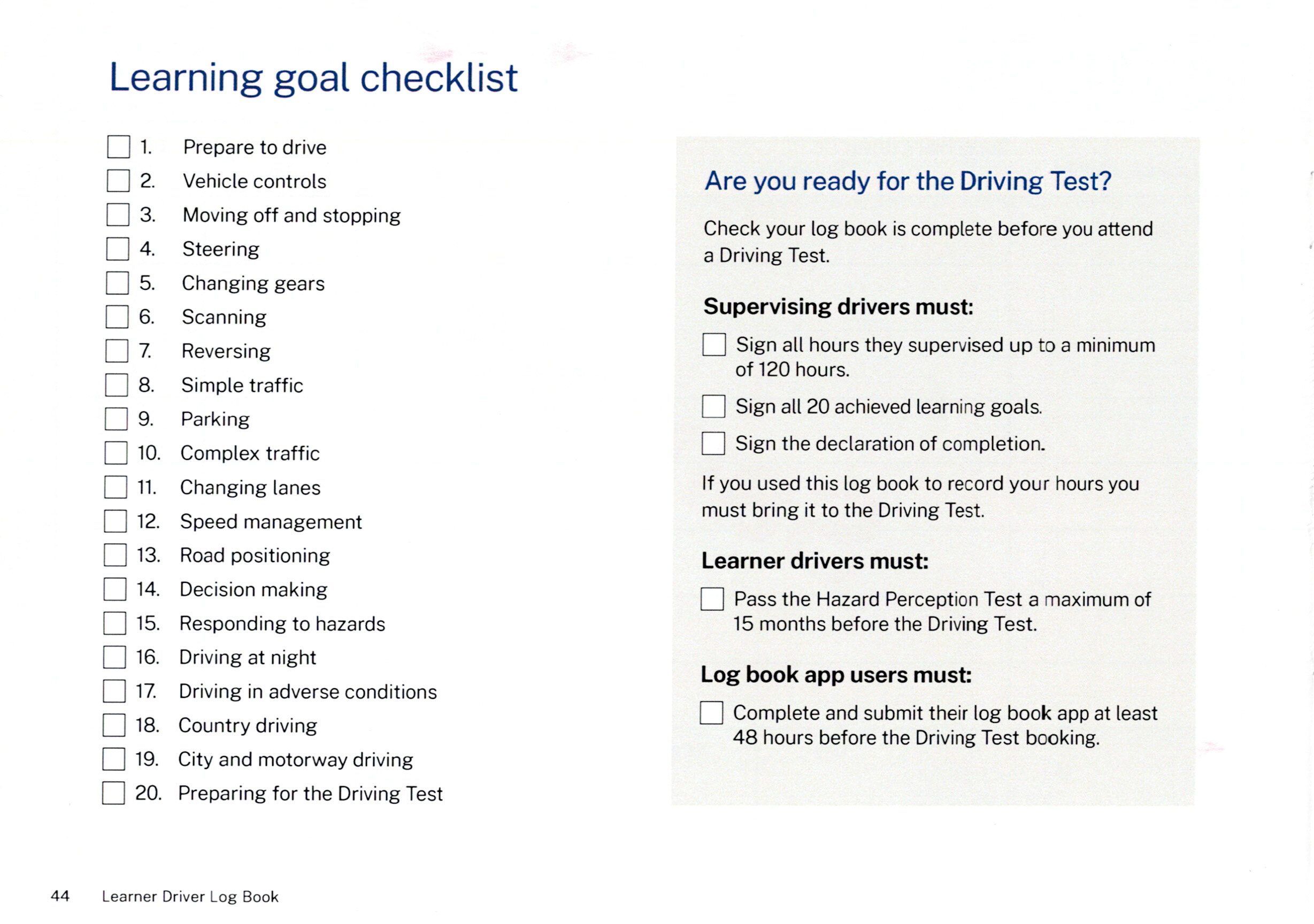
Learning Goal Checklist
Pre-test verification checklist: ensuring all 20 learning goals are signed off, 120 hours are logged, and digital apps are transmitted 48 hours in advance.
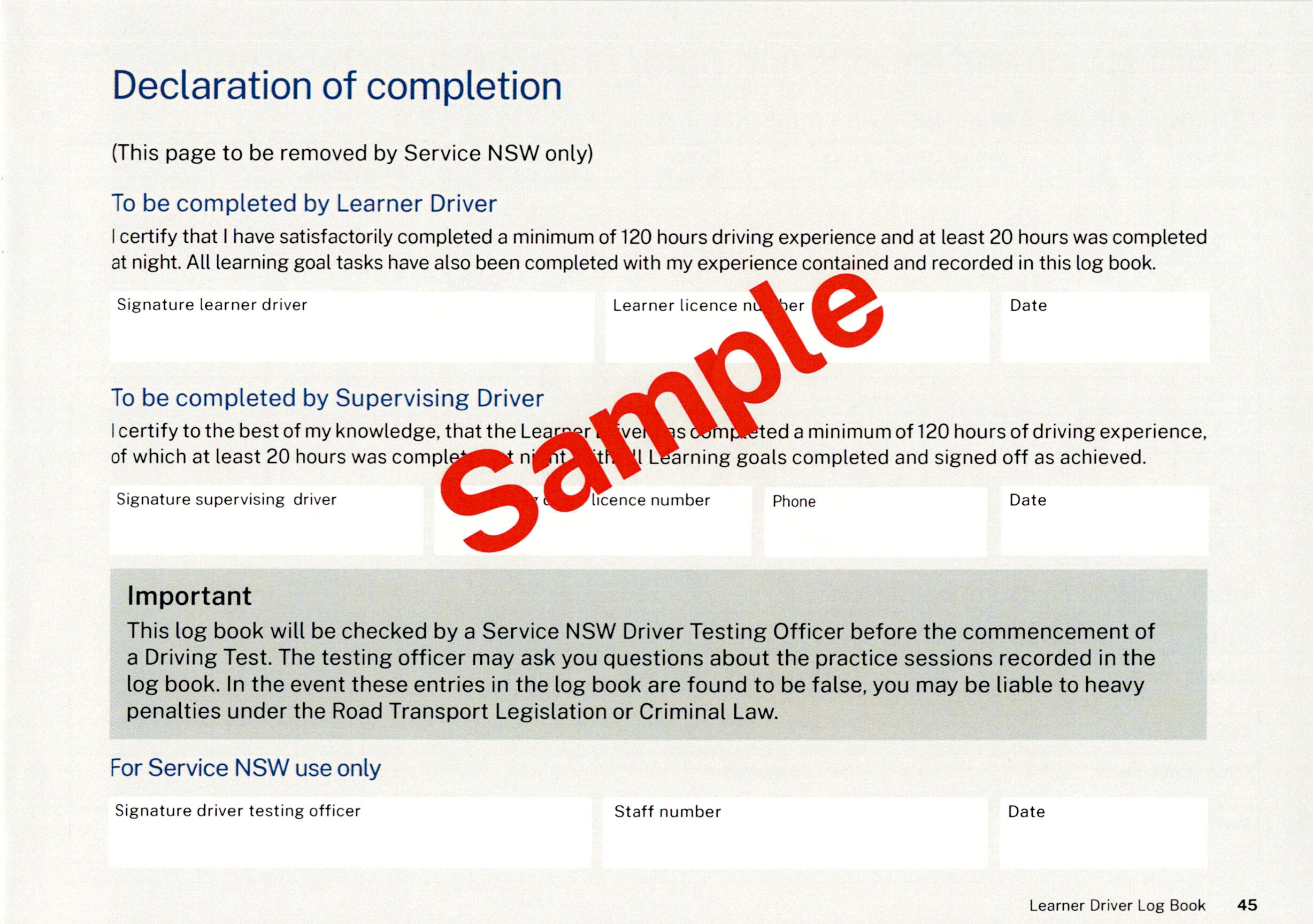
Declaration of Completion
Official statutory declaration confirming logbook authenticity, signed by the learner and supervisor, and detached solely by Service NSW examiners.
14. 3-for-1 Lessons & Safer Drivers Course Records
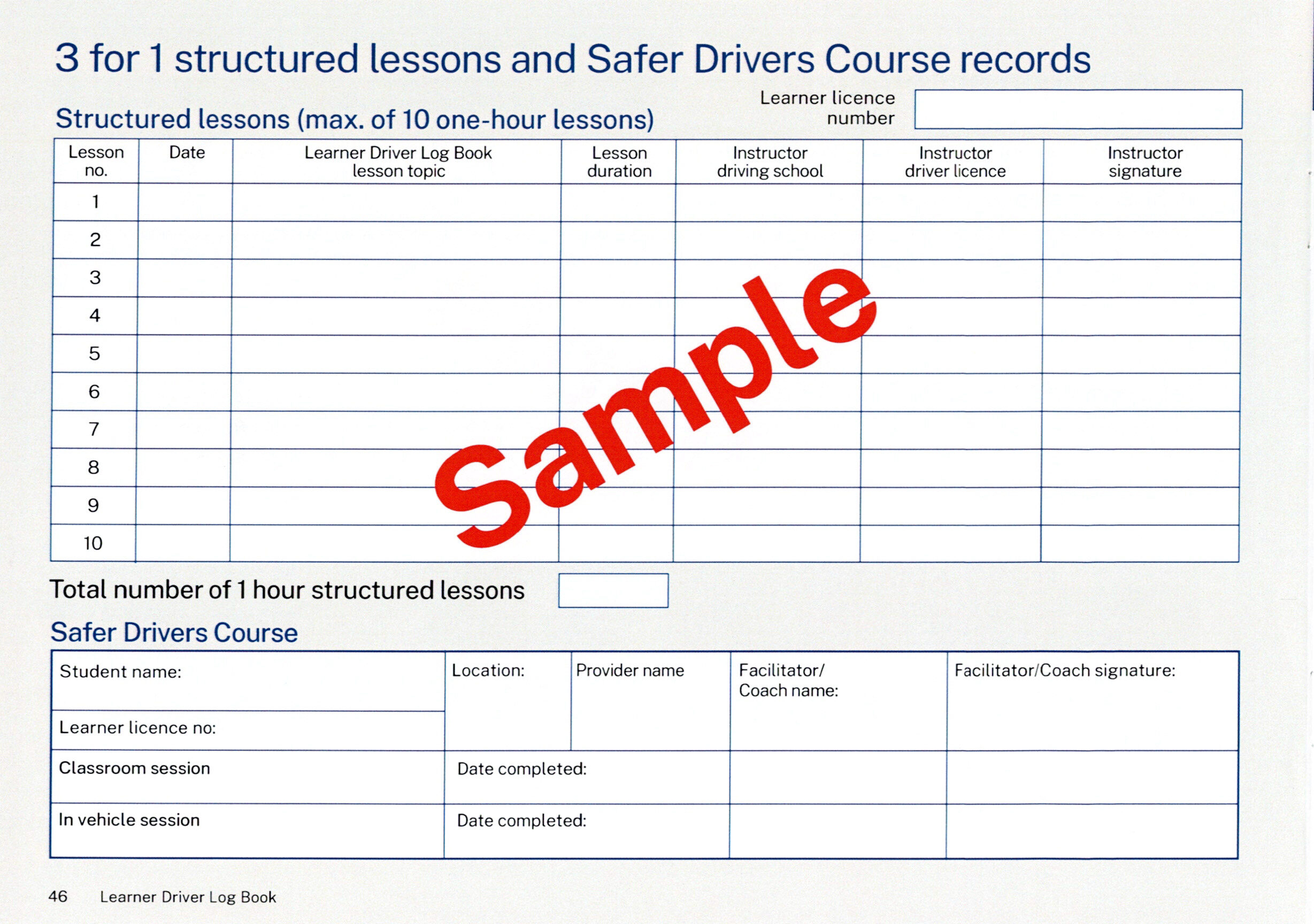
Structured Lessons & SDC Records
Official recording form for up to 10 one-hour structured lessons (30 logbook hours) and provider sign-offs for the Safer Drivers Course classroom and in-vehicle sessions.
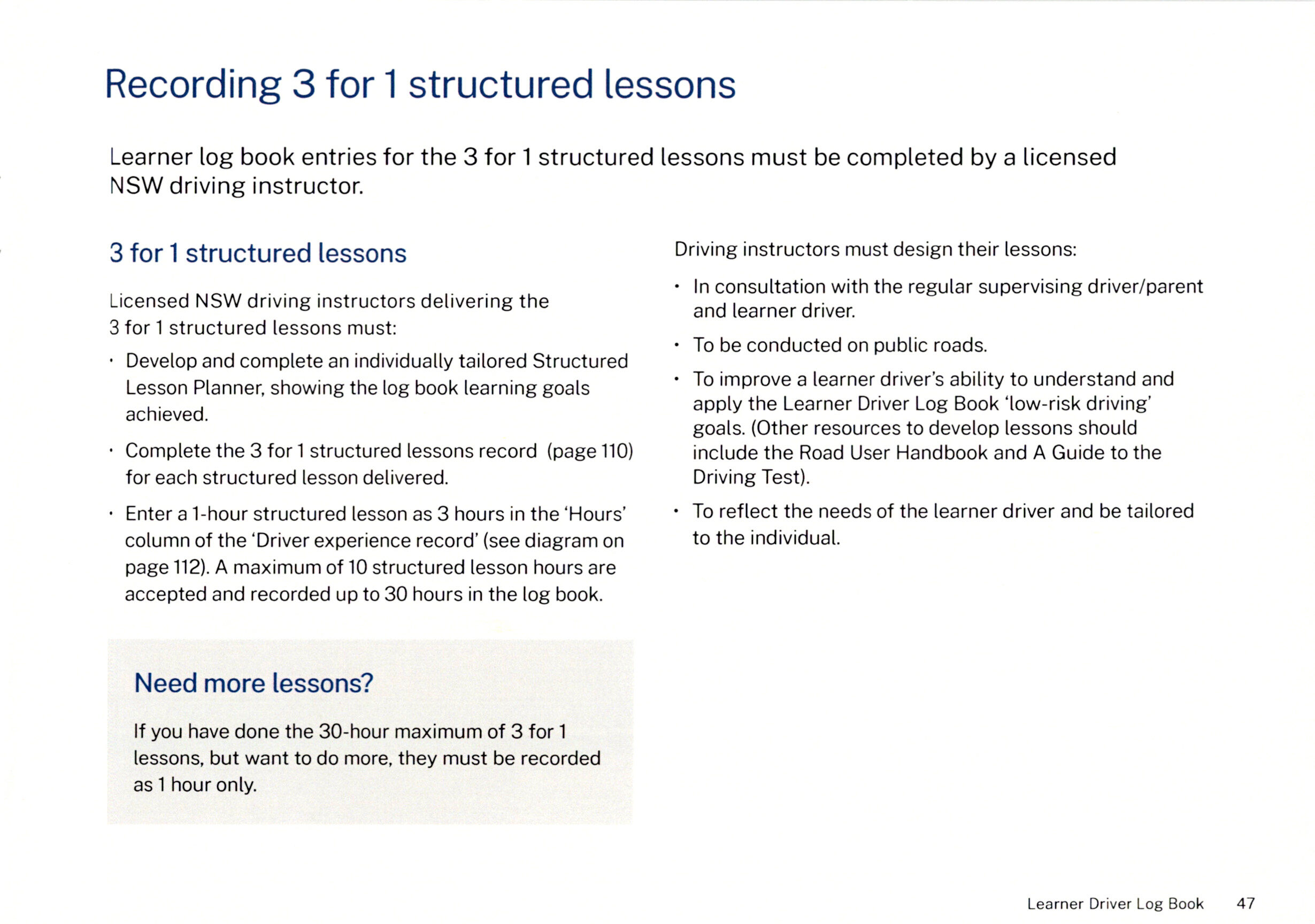
3-for-1 Structured Lessons Guide
Instructor rules for structured delivery: lesson planning across low-risk driving topics, logbook entry standards, and recording additional lessons at 1:1 once the 30-hour cap is reached.
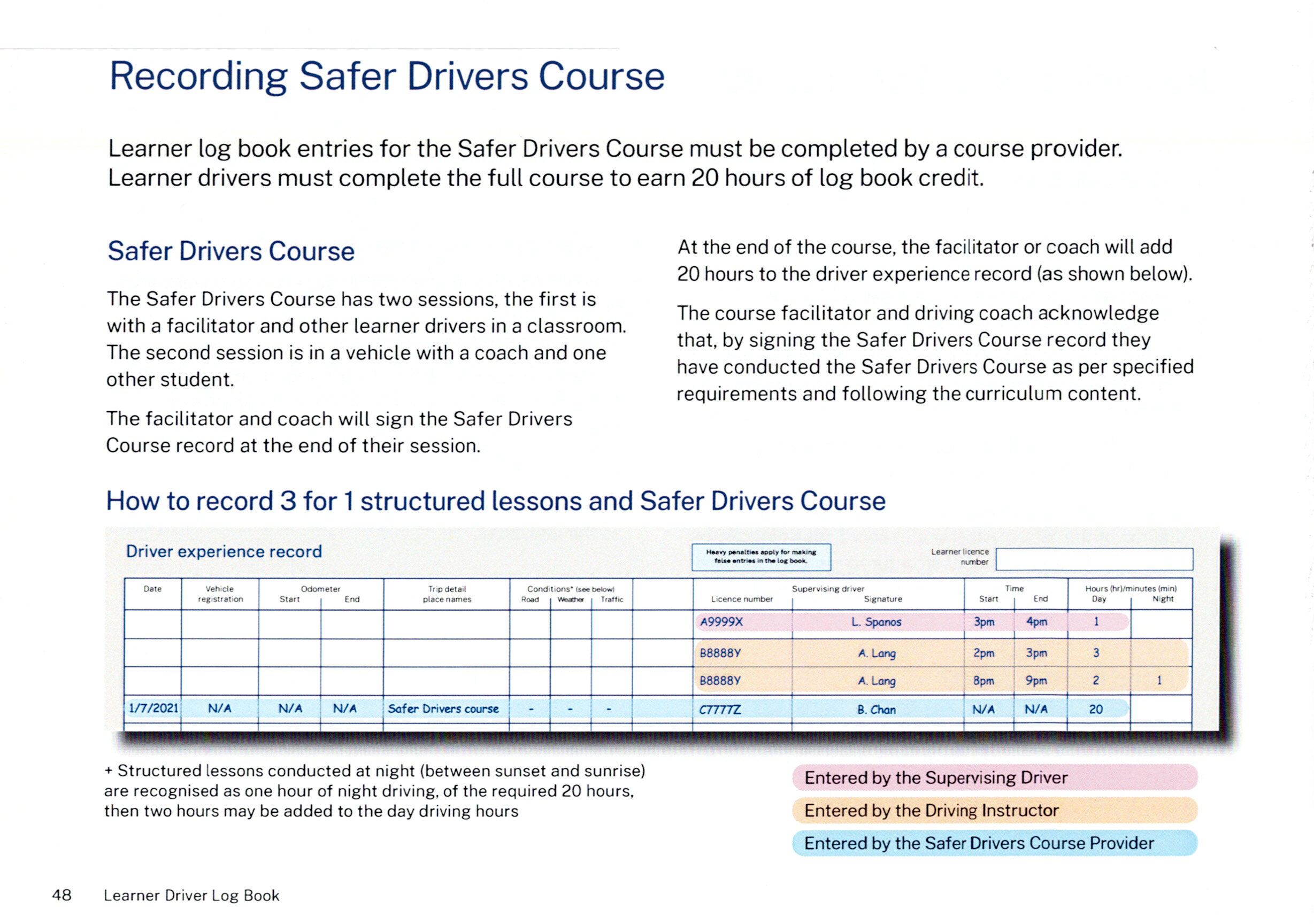
Safer Drivers Course Logging
Earning 20 logbook credit hours: course structure, facilitator and coach sign-offs, and recording evening structured lessons as 1 night hour plus 2 day hours.

Statutory Publication Details
Official Transport for NSW publication catalogue details, Service NSW 13 22 13 contact helpline, and legal road rules copyright disclaimers.
Looking for In-Car Video Route Masterclasses?
Watch on-road route audits and hazard analysis across Castle Hill, Blacktown, Richmond, and St Marys testing centres, mapped directly to TLI41225 competencies.
Open Video Hub & Learning Resources →